
Trend lists are easy to write and hard to use. Most repeat the same global predictions with a country name swapped in, and leave marketers no clearer about what to actually change in their plans. This guide takes a different approach. It looks at the digital marketing trends in Qatar that are already visible in local data and consumer behaviour, explains what each one means for Doha businesses, and suggests a practical response for 2027.
Where we refer to figures, we cite the source. Where we’re making a judgement about where things are heading, we say so. If you’d like to turn these trends into a plan for your brand.
The Context Behind Digital Marketing Trends in Qatar
Qatar’s consumers are among the most connected in the world, and online spending keeps rising. Market research firm Mordor Intelligence, as reported by The Peninsula in February 2026, projects Qatar’s online sales market at around QR18 billion in 2026, up from roughly QR16.5 billion in 2025, with continued growth expected over the following years. Quick-commerce, buy-now-pay-later options and B2B e-commerce are among the growth drivers it highlights.
At the same time, social platforms reach very large audiences relative to the population, and consumers increasingly use AI tools while shopping. Together, these shifts shape the trends below.
1. AI Is Changing How Qatar Consumers Search and Shop
A study released by Visa in mid-2026, as reported by regional tech media, found that 90 percent of consumers in Qatar use AI-powered technologies at some point in their purchasing journey: to search for products, get personalised recommendations and compare options. At the same time, AI-generated answers are appearing more often in search results, and conversational AI assistants are becoming another place people look for recommendations.
What it means?
Visibility is no longer only about ranking a blue link. Brands need clear, well-structured, trustworthy content that AI systems can understand and summarise accurately, plus strong reviews and consistent information across the web.
How to respond in 2027?
Answer real customer questions on your website in plain language, in both Arabic and English. Keep business details consistent across your website, Google Business Profile and directories. Build genuine reviews, and use structured data where it helps search engines understand your pages. Treat AI visibility as an extension of good SEO, not a separate trick or shortcut.
2. Arabic Search Is an Under-Used Opportunity
Many Qatar businesses still treat Arabic as a translation afterthought. When MediaSine’s research reviewed live search results for core digital marketing terms in September 2026, the Arabic Qatar results were the weakest checked, featuring social profiles, directories and agencies based outside Qatar rather than strong local pages.
What it means?
For many categories, native Arabic content can reach page one faster than English, because fewer competitors invest in it properly. That window is unlikely to stay open forever, so early movers benefit most.
How to respond in 2027?
Research Arabic keywords separately, write native Arabic pages for your most important services and set up bilingual sites correctly. Our guide to Arabic SEO in Qatar explains how to decide which language to prioritise.
3. Short-Form Video Keeps Leading Discovery
Vertical video on TikTok, Snapchat and Instagram remains the main way many Qatar consumers discover new brands, restaurants and products. DataReportal’s Digital 2026 report showed TikTok and Snapchat both growing their reported ad audiences in Qatar through 2025, with Snapchat’s audience the most gender-balanced of the major platforms.
How to respond in 2027?
Plan a sustainable rhythm of short-form video rather than occasional campaigns. Shoot once and edit separately for each platform, lead with the product or experience in the first seconds, and add Arabic and English captions. Our guide to platform choices in Qatar covers where each platform fits.
4. Authentic Content and Creators Over Polish
Audiences increasingly respond to content that feels real: customers, staff, founders and creators speaking in their own voice. Highly produced brand content still has a place, but it’s often outperformed by simpler, more personal videos on social platforms.
How to respond in 2027?
Balance polished hero content with regular, lighter content from your team and customers. Work with creators whose audiences are genuinely in Qatar, brief them clearly, and disclose paid partnerships. Our guide to UGC vs agency content will explore how to balance the two.
5. Social Commerce and Messaging Close the Sale
Many purchases in Qatar now start on social media and finish in a conversation: an Instagram DM, a WhatsApp message or a booking link sent in chat. Payment links, buy-now-pay-later options and local wallets make it easier to complete purchases without leaving the conversation.
How to respond in 2027
Treat your inbox as a sales channel. Set response-time standards, use saved replies for common questions, connect WhatsApp to your listings and ads, and make checkout or payment links simple. Track how many conversations become orders, not just how many messages arrive. Slow replies are one of the most common reasons interested customers buy elsewhere.
6. First-Party Data and Better Measurement
Privacy changes and the decline of third-party tracking make it harder to measure campaigns using platform data alone. Brands that collect their own data, such as customer lists, WhatsApp opt-ins, loyalty members and email subscribers, are better placed to reach customers again and measure results.
How to respond in 2027?
Set up proper conversion tracking, including server-side options where available. Build ways for customers to opt in to future contact. Use consistent attribution and ask new customers how they found you. Judge campaigns on enquiries and sales rather than impressions, and keep data collection transparent and consent-based.
7. Seasonal and Cultural Moments Grow in Importance
Qatar’s marketing calendar, from Ramadan and Eid to Qatar National Day and major sporting and cultural events, concentrates attention and spending. These moments are becoming more competitive, with more brands planning campaigns earlier and investing more.
How to respond in 2027?
Map the year’s key dates in January, plan creative and offers well ahead, and remember that discounts and giveaways may need approval from the Ministry of Commerce and Industry. Lead with authentic, culturally respectful content rather than generic sales messages.
8. Search Moves Beyond Google
Younger audiences increasingly search directly on TikTok, Instagram and YouTube for restaurants, products, reviews and tutorials. Google remains central, especially for high-intent searches, but discovery is spreading across platforms.
How to respond in 2027?
Make social content searchable: say key words out loud in videos, add them to captions and on-screen text in Arabic and English, and answer the questions people actually type. Treat platform search as part of your visibility strategy, alongside SEO and your Google Business Profile.
9. The Region Becomes One Market for Many Brands
Among the clearest marketing trends in the GCC for 2027 is that more brands are planning across several Gulf markets at once. Qatar businesses are expanding into Saudi Arabia and the UAE, and regional brands are entering Qatar. That brings opportunities, and also the risk of treating Qatar as an afterthought in regional campaigns.
How to respond in 2027?
If you sell across the region, build campaigns that share a core idea but adapt language, references and platforms for each market. If you’re a Qatar-focused brand, use your local knowledge as a competitive advantage against regional competitors. Regional agencies and brands often struggle with Gulf Arabic, local references and Qatar-specific seasons, which is exactly where a local brand can stand out.
Trends to Watch Without Overreacting
Some developments deserve attention without immediate heavy investment. Voice search, augmented reality shopping, new social platforms and fully automated AI-generated content all attract headlines. Some will matter for specific categories, such as AR try-ons for beauty and eyewear, or voice search for quick local queries. For most Qatar businesses, though, they’re worth testing on a small scale rather than building a strategy around.
The same caution applies to AI-generated content. AI tools can speed up research, drafting and editing, but content published without human review, local knowledge and native Arabic expertise tends to read generically and may not earn trust or rankings. Among the digital marketing trends in Qatar, the winners in 2027 are likely to be brands that use AI to work faster while keeping human judgement, local insight and genuine expertise at the centre of what they publish.
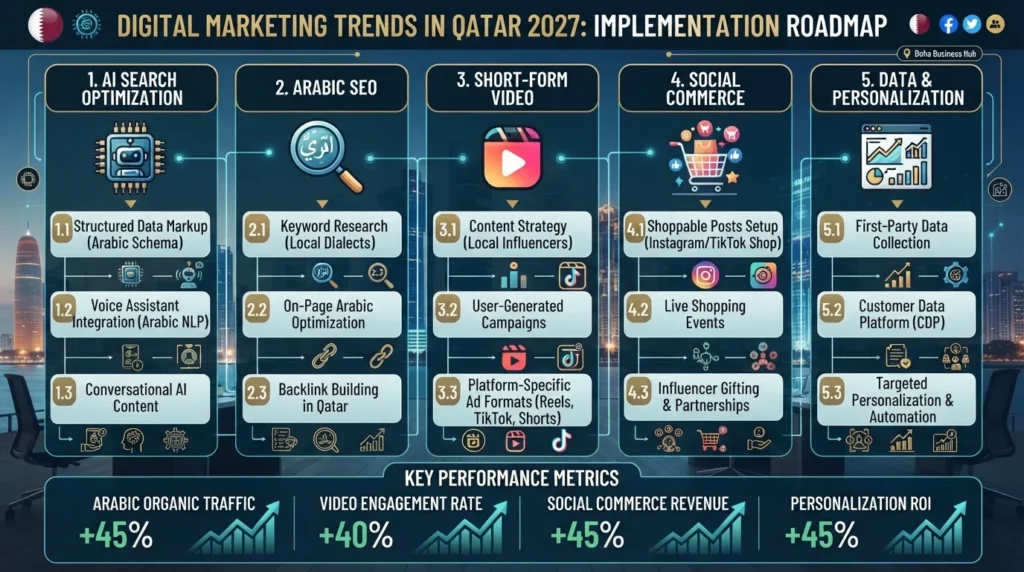
Turning Trends Into a 2027 Plan
Not every trend deserves equal attention. Start by asking which ones affect how your customers find and choose you. A Doha restaurant might prioritise short-form video, messaging and seasonal campaigns. A B2B company might focus on AI-ready content, Arabic SEO and better measurement. An online store might prioritise social commerce, first-party data and payments.
Pick two or three priorities, set measurable goals for each, assign owners and budget, and review progress every quarter. Trends are only useful when they change what you actually do, and the most useful digital marketing trends in Qatar are the ones you can measure in enquiries, bookings and sales.
A note on predictions
The trends above are based on current data and our observations of the Qatar market. They’re informed judgements, not guarantees. Platform features, regulations and consumer habits can change quickly, so revisit your plan regularly and let your own results guide you.
Plan 2027 With Purpose
The digital marketing trends in Qatar heading into 2027 point to a market that rewards brands who are useful, authentic and easy to buy from, in both Arabic and English. Focus on the trends that matter to your customers, plan seasonal moments early, invest in measurement and keep testing. Do that, and 2027 can be the year your marketing works harder rather than louder.
Plan 2027 with us.
mediaSine helps Qatar brands turn market trends into practical marketing plans.
Frequently Asked Questions
Based on current data, the most important are AI-influenced search and shopping, the opportunity in Arabic search, short-form video, authentic creator content, social commerce through messaging, first-party data, seasonal moments, search beyond Google and regional campaigns.
No. Choose the two or three trends most relevant to how your customers find and buy from you, and do them well rather than spreading effort thinly.
Yes. AI systems draw on well-structured, trustworthy web content, so strong SEO foundations, clear answers to customer questions and consistent business information remain essential.
Review performance monthly and revisit priorities each quarter. Update your overall plan at least once a year, or sooner if a major platform or market change affects your business.
