
Your brand identity will outlive most of the decisions you make this year. It will sit on your shopfront, your packaging, your website, your Instagram grid and every invoice you send for years to come. So when it’s time to create or refresh it, the question of who does the work matters. The branding agency vs freelancer choice isn’t about which is better in general. It’s about how much of your brand needs building, and how many people need to build it.
This guide compares the two honestly, explains what a full branding project actually involves, and helps you decide which route fits your business. If you’re already leaning towards a team, you can see MediaSine’s brand identity services. If not, read on; for some projects, a talented freelancer is exactly the right choice.
What a Branding Project Actually Involves
Many businesses start by asking for “a logo”, but a logo is only one piece of a brand identity. A complete project usually includes several layers, and knowing which ones you need is the key to choosing the right partner.
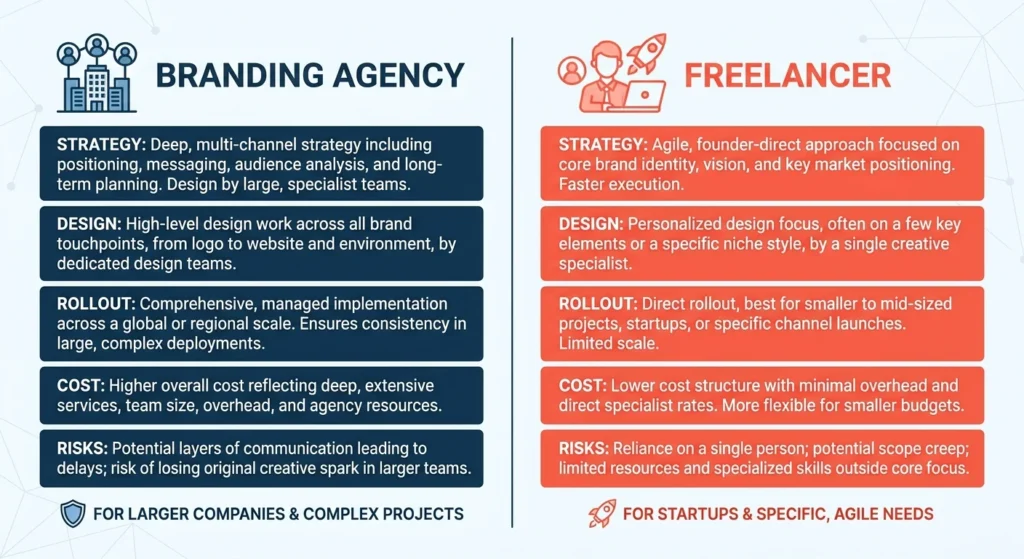
In practice, much of the branding agency vs freelancer decision depends on how many of the layers below you need covered.
Strategy and positioning
Before anything is designed, someone needs to answer the big questions: who you’re for, what makes you different, how you want to be perceived and how you’ll stand apart from competitors. This thinking shapes everything that follows. For a new business, it may also include naming.
Visual identity
This is the part most people picture: the logo and its variations, colour palette, typography, imagery style, icons and patterns. Good brand identity design creates a system that works consistently, from a tiny social media avatar to a large shop sign.
Verbal identity
How your brand sounds matters as much as how it looks. Tone of voice, key messages, taglines and naming conventions guide everything from website copy to Instagram captions. In Lebanon, that often means defining a voice in English, Arabic and sometimes French.
Guidelines and rollout
A brand identity only works if it’s applied consistently. Brand guidelines explain how to use the logo, colours and fonts correctly. Rollout covers applying the identity to real touchpoints: stationery, signage, packaging, social media templates, the website and uniforms.
The Case for a Freelance Designer
Lebanon has a deep pool of talented independent designers, and for many projects they’re an excellent choice.
Direct access and a personal style
With a freelancer, you work directly with the person designing your brand. There are no account managers in between, conversations are quick and feedback goes straight to the person holding the pen. If you love a particular designer’s style, hiring them gives you exactly that eye.
Lower cost for focused projects
Freelancers usually have lower overheads than agencies, so focused projects, such as a logo, a simple visual identity or packaging for one product, often cost less. For startups and small businesses with limited budgets, that can make professional design accessible much earlier.
Speed and flexibility
A freelancer can often start quickly and adapt to your schedule. For smaller projects with clear briefs, the process can be faster than an agency’s structured approach.
The Case for a Branding Agency
An agency’s advantage is breadth: strategy, design, copy and rollout handled by people who work together every day.
Strategy before design
Agencies typically start with research and positioning before any design work. That matters most when you’re launching something new, repositioning an existing business or entering a crowded market. A logo built on clear strategy is easier to defend and less likely to need replacing in two years.
Several disciplines in one team
A full identity needs a strategist, designers, a copywriter and often a web designer, photographer or packaging specialist. An agency brings them together, so the logo, voice, website and social templates are developed as one system. The rollout across touchpoints, from graphic design for print and social to your website, stays consistent.
Continuity and capacity
Brands keep needing work after launch: new campaigns, new products, new templates. An agency can continue applying and evolving the identity, and the work doesn’t stop if one person becomes unavailable. For businesses expanding beyond Lebanon, an agency with regional experience can also adapt the brand for new markets.
The Risks on Each Side
Each model has a typical weak spot, and knowing it helps you plan around it.
With freelancers, the main risks are scope and continuity. A brilliant logo designer may not be the right person to write your tone of voice or build your website, so projects can end up split across several people with no one owning the whole. If the freelancer becomes busy or moves on, getting quick updates can be difficult.
With agencies, the risks are cost and distance. You pay for the team and the process, and on smaller projects that can feel like more than you need. In some agencies, the senior people who pitched the work are less involved day to day, so it’s worth asking who will actually design your brand.
Branding Agency vs Freelancer: Which Fits Your Situation?
Most businesses fit one profile more clearly than the other. Here’s how the decision usually plays out.
When a freelancer is likely the better fit?
You need a logo or a simple visual identity for a new small business. Your positioning is already clear, and you know what you want to say. Your budget is limited, and you can manage the brief and feedback yourself. Or you’ve found a designer whose style matches your vision exactly.
When an agency is likely the better fit?
You’re launching a brand that needs strategy, naming or positioning, not just design. You’re rebranding an established business with many touchpoints to update. You need the identity rolled out across a website, packaging, signage and social media in one coordinated effort. Or you plan to expand into the Gulf or other markets and need a brand that works in Arabic and English from the start. In these cases, a branding agency in Lebanon with a multidisciplinary team is usually the safer route.
The hybrid route
Some businesses combine the two: an agency or strategist for positioning and guidelines, then freelancers for ongoing design work. Others hire a freelancer for the logo and an agency for the website and rollout. Hybrids work when one party owns the brand guidelines and everyone else follows them.
Bilingual Brands: A Lebanese Consideration
For many Lebanese businesses, a brand needs to work in both Latin and Arabic script. Designing an Arabic logotype that feels like a natural partner to the Latin version, rather than a literal translation, takes specific skills. If you’re selling across Lebanon and the Gulf, or plan to, check that whoever you hire has real experience with bilingual identity design and can show examples. This applies equally to freelancers and agencies.
Ask how the Arabic and Latin versions were developed: side by side from the start, or one adapted from the other later. Identities designed as a pair usually feel more balanced on signage, packaging and social media, where both scripts often appear together. It’s also worth testing both versions at small sizes, such as app icons and profile pictures, before signing off.
What You Should Receive at the End?
Whichever route you choose, make sure the deliverables are clear before work starts. At a minimum, you should receive:
- Logo files in vector and web formats, in all agreed variations
- Colour codes for print and screen
- Font names and licences, or clear instructions for buying them
- Brand guidelines explaining correct use
- Written transfer of ownership of the final designs to your business
It’s also wise to check trademark availability for your name and logo before you invest heavily in rollout.
Questions to Ask Before You Hire Either
Whichever way you lean, the same questions will tell you a lot about how a freelancer or agency works. Ask to see the process behind their portfolio, not just the finished logos, and listen for how they talk about your business rather than their style.
- What happens before design starts? Look for questions about your audience, competitors and goals.
- How many concepts and revision rounds are included?
- Who will actually do the design, and who will you speak to?
- Can you show bilingual work with Arabic and Latin versions?
- What support is available after the guidelines are delivered?
The answers often settle the branding agency vs freelancer debate on their own. A freelancer who asks sharp strategic questions and shows a strong bilingual portfolio may be all you need. An agency that jumps straight to mood boards without understanding your business may not be worth its higher fee. Judge the thinking, not just the label.
How Cost Compares?
Freelancers generally cost less than agencies for comparable projects, but the comparison only works if the scope is the same. A freelancer’s logo quote and an agency’s full identity proposal aren’t competing offers; they describe different projects. Compare like with like: strategy, number of concepts, revision rounds, deliverables and rollout. Our guide to logo design costs in Lebanon explains what moves the price for logo work specifically.
Frequently Asked Questions
Price matters, but scope matters more. A freelancer is often the efficient choice for focused design work; an agency is usually better when you need strategy, multiple disciplines and a coordinated rollout.
A logo can take a few weeks. A full identity with strategy, guidelines and rollout often takes a couple of months or more, depending on the number of touchpoints and how quickly decisions are made.
Yes. Many businesses update digital channels first, then signage, packaging and stationery as stock runs out. A clear set of guidelines keeps a gradual rollout consistent.
You should. Agree in writing that ownership of the final designs transfers to your business once paid, whether you work with a freelancer or an agency.
Choose the Partner That Matches the Job
The branding agency vs freelancer question comes down to scope. If you need a strong logo or a focused identity and can manage the process yourself, a talented freelancer may be ideal. If you need strategy, a multidisciplinary team and a coordinated rollout across many touchpoints, an agency usually delivers more value. Either way, define what you need, insist on clear deliverables and ownership, and choose the partner whose experience matches the job.
Discuss your brand project.
Tell us whether you’re launching, refreshing or rebuilding your brand, and mediaSine will give you an honest view of the scope you need.
