
Most business websites in Qatar launch in English, add an Arabic version “later”, and then wonder why the Arabic pages never bring in customers. Others translate everything at once and spread a modest SEO budget across two languages before either has a chance to rank. Both approaches skip the real question: where do your customers search, and where can you actually win? Arabic SEO in Qatar can be one of the most promising opportunities in the market, but only if you decide deliberately which language leads, which follows and how the two versions work together.
This guide helps you make that decision. It covers how search splits between Arabic and English in Qatar, why the Arabic results are often easier to compete in, a simple framework for choosing a priority, and how to build a bilingual site without the common mistakes. If you’d like a team to plan it with you, see mediaSine’s approach to bilingual SEO in Qatar.
Why Language Matters So Much for Search in Qatar
Qatar’s audience is unusually mixed. Qatari nationals and Arab expatriates often search in Arabic, while much of the large international population searches in English. Many people do both, switching depending on the topic: English for a software tool or a hotel booking, Arabic for a local service, a government-related question or something they’d discuss with family. A single customer might search “AC repair Doha” on Monday and صيانة مكيفات الدوحة on Thursday.
Search engines treat these as different queries with different results. An English page, however strong, generally won’t rank for an Arabic search, and a machine-translated Arabic page rarely satisfies the people who make one. That’s why language is a strategic SEO decision in Qatar, not just a translation task.
The Opportunity in Arabic SEO in Qatar
When mediaSine’s SEO research reviewed live search results for core digital marketing terms in Qatar in September 2026, the Arabic results page was the weakest of all the markets and languages checked. Rather than strong Qatari agency pages, the results included a social media profile, a blog post, a directory listing and agencies based outside Qatar. English Qatar results, by contrast, were held by established local agencies with dedicated pages.
That’s a single snapshot of one set of searches, not a rule for every industry, but the pattern is common across Gulf markets: fewer businesses invest in genuinely useful Arabic pages, so the competition for Arabic searches can be thinner. For many Qatar businesses, that makes Arabic SEO in Qatar a realistic route to page-one visibility that would take much longer to reach in English.
The opportunity won’t last forever. As more Qatar businesses recognise the gap, Arabic results will become more competitive. Brands that invest in Arabic SEO in Qatar now, with genuinely useful native pages, are more likely to hold strong positions once others catch up. Early, well-built pages also earn links, reviews and engagement that later entrants will have to work harder to match.
Why the gap exists
Several reasons explain it. Many sites launch English-first and treat Arabic as a translation project. Arabic content is harder to produce well, because it needs native writers rather than translation tools. And some businesses assume their customers all search in English. Each of these leaves room for a competitor willing to do Arabic properly.
Arabic or English First? A Practical Framework
There’s no universal answer, but four questions usually make the priority clear.
1. Who are your customers?
If your customers are mainly Qatari families, Arab expatriates, government entities or local businesses that work in Arabic, Arabic search deserves early priority. If you mainly serve international residents, tourists or multinational companies, English may carry most of the demand. Our guide to audience segments in Qatar can help you define who you’re really serving.
2. Where is the search demand?
Check how many people search for your key services in each language. Use Google Keyword Planner with Qatar as the location, compare Arabic and English versions of your main terms, and look at Google Search Console if your site already has traffic. Volumes for niche services can be small, so look at the overall picture rather than single keywords.
3. How strong is the competition?
Search your main terms in both languages and look at what ranks. If English results are crowded with strong local pages and directories while Arabic results are thin, you’ve found an opening. If both are crowded, prioritise the language where your customers are.
4. Can you produce quality content in both?
Be honest about capacity. One language done well beats two done poorly. If you can only produce native-quality content in one language for now, start there and add the second when you can do it properly.
Three Common Priority Patterns
Most Qatar businesses end up in one of these patterns.
Arabic first
Suits businesses serving Qatari and Arab customers: home services, clinics, education, family-focused retail, real estate aimed at locals and B2G suppliers. Arabic pages lead, with English versions covering the most important services.
English first, Arabic for priority services
Suits businesses with mainly international customers that still want Arabic visibility for their highest-value services. English carries the full site, while Arabic pages focus on the services where Arabic demand and weaker competition overlap.
Fully bilingual from the start
Suits established businesses with mixed audiences and the resources to maintain both languages properly. Every important page exists in both languages, each written natively and optimised for its own keywords.
Doing Arabic Website SEO Properly
Good Arabic website SEO isn’t a translated copy of the English site. It starts with research and is written for Arabic readers.
Research Arabic keywords separately
Arabic searches vary in spelling, dialect and phrasing, and English keywords don’t translate neatly. Build Arabic keyword lists from real customer language, Google suggestions and search data, then group variants by intent. Our guide to Arabic keyword research explains the method, which applies in Qatar as well as Saudi Arabia, though local phrasing differs.
Write native Arabic content
Have native Arabic writers, ideally familiar with Gulf audiences, create each page from a brief rather than translating line by line. Cover the questions Arabic-speaking customers actually ask, which may differ from the English version.
Optimise every on-page element
Arabic pages need their own title tags, meta descriptions, headings, image alt text and internal links, all in Arabic. A page with Arabic body text but English titles sends mixed signals to search engines and looks odd in results.
Build local signals in Arabic
Your Google Business Profile, reviews and local listings matter for both languages. Make sure your business name, services and descriptions are clear in Arabic as well as English where the platform allows.
The Technical Side of Bilingual SEO in Qatar
Effective bilingual SEO in Qatar depends on a clean technical setup, so search engines understand which page serves which language.
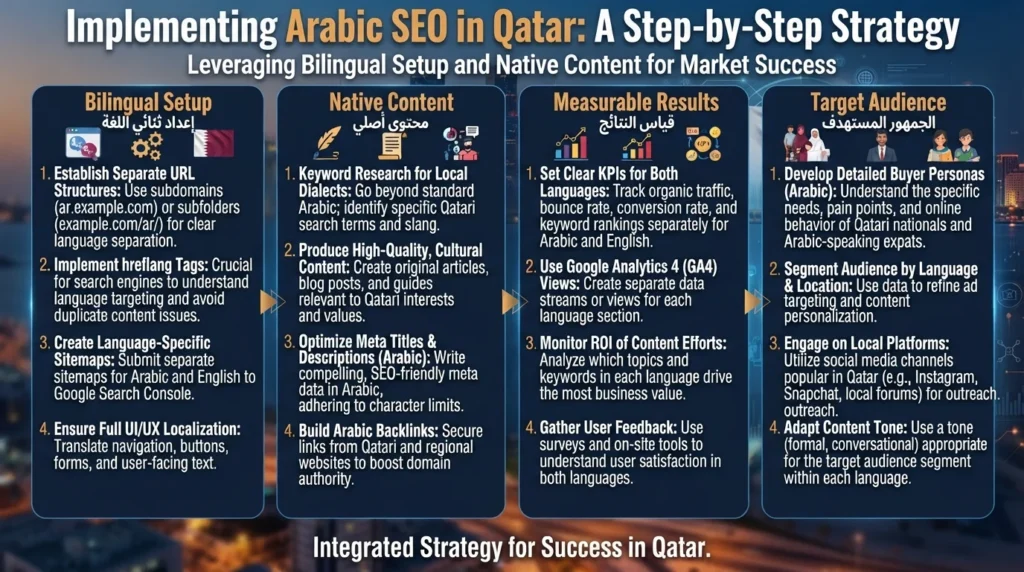
Give each language its own URL, usually through subfolders such as /ar/ for Arabic, rather than switching languages on the same URL. Add hreflang tags linking each page to its equivalent in the other language, and make sure every pair points to each other correctly. Avoid automatically redirecting visitors based on browser language, which can stop search engines crawling both versions; offer a clear language switcher instead. Set the correct language and right-to-left direction in the page code for Arabic pages, and include both versions in your XML sitemap.
Finally, keep the two versions in step. When you update prices, services or contact details in English, update the Arabic page too. Out-of-date Arabic pages are one of the quickest ways to lose trust with Arabic-speaking visitors.
An Example: A Doha Home Services Company
Picture a company offering cleaning and maintenance across Doha. Its English site ranks reasonably for a few services, but competition is strong. Arabic searches for the same services show weaker results, including directory listings and agencies outside Qatar. The company decides to keep its English pages, then builds native Arabic pages for its four highest-value services, each with Arabic titles, FAQs and a WhatsApp button, linked to the English versions through hreflang. It updates its Google Business Profile with Arabic service descriptions and asks satisfied Arabic-speaking customers for reviews. Within a few months, the Arabic pages start appearing for searches where the English site never competed. This is an illustrative scenario, not a client example, and timelines vary by competition and site history.
Measuring Arabic and English Separately
Track each language on its own so you can see what’s working. In Google Search Console, filter performance by page path, such as /ar/, to compare Arabic and English impressions, clicks and positions. In analytics, compare enquiries and conversions from each version. Watch which Arabic queries start bringing impressions, and expand content around them. Over time, the data will show whether to shift more effort into Arabic, English or both.
Common mistakes to avoid
The most frequent mistakes are machine-translating the English site, leaving Arabic titles and meta descriptions in English, using one URL for both languages, forgetting hreflang, redirecting users automatically by browser language and letting the Arabic version fall out of date. Fixing these alone can put a site ahead of many competitors, because so much Arabic SEO in Qatar still stops at a quick translation.
Choose Your Language Strategy on Purpose
The right answer to Arabic versus English depends on your customers, search demand, competition and capacity. For many businesses, Arabic SEO in Qatar offers a faster route to visibility because fewer competitors do it well. Decide which language leads, research and write each one natively, set up the technical foundations correctly and measure both separately. Do that, and your site can reach Qatar customers in whichever language they search.
Get a bilingual SEO plan
mediaSine can review your site’s Arabic and English visibility in Qatar and recommend which language to prioritise
Frequently Asked Questions
Often, but not always. Arabic results for many commercial searches in Qatar have fewer strong local pages, which can make ranking faster. It depends on your industry, so compare both sets of results for your main terms.
Translation alone rarely works well. Arabic keywords, phrasing and questions differ from English. Native Arabic writing based on Arabic keyword research performs better and builds more trust.
Usually not. Most businesses use Arabic subfolders on the same domain, which keeps authority in one place. The key is separate URLs per language and correct hreflang tags.
Like any SEO, it usually takes several months. Where Arabic competition is weaker, new pages may gain visibility sooner, but site history, content quality and technical setup all play a part.
