
Most small and medium businesses in the Kingdom don’t struggle to find places to spend marketing money. Snapchat, TikTok, Instagram, Google, creators, a new website, photography, an agency retainer: every option looks promising. The hard part is deciding how much to spend in total and how to divide it so the money actually produces customers. A well-planned digital marketing budget in Saudi Arabia answers both questions before the first riyal is spent, and it accounts for local realities like VAT, seasonal peaks and creator licensing.
This guide gives Saudi SME owners a practical framework: how to set a total budget, the building blocks it should include, how to allocate across channels, the Saudi-specific factors to plan for, sample splits for different businesses and how to measure return. If you’d like help building yours, see our digital marketing agency support in KSA.
How Much Should a Saudi SME Spend on Marketing?
There’s no single right number, but three approaches help you find yours. Most businesses use a combination.
A percentage of revenue
A widely cited rule of thumb, repeated by agency marketplace Sortlist among others, puts marketing budgets somewhere between 5 and 25 percent of revenue. That range is broad for a reason: a stable business protecting its position sits at the lower end, while a new brand or one entering a competitive category may need to spend at the higher end for a period. Use the percentage as a sense check, not a rule.
Working back from your goals
A more precise method starts with the result you want. If you need 100 new customers a month, estimate how many leads that requires, what each lead is likely to cost through your chosen channels and what percentage convert. Multiply it out, and you have a goal-based budget. Your estimates will improve once campaigns are running and you have real data to replace assumptions.
Launch versus maintenance
Entering the market, launching a new product or opening a branch usually needs a heavier initial investment to build awareness quickly. Once established, many businesses shift to a steadier maintenance budget focused on efficient channels and repeat customers.
For reference, Sortlist’s guidance for Riyadh suggests that a basic digital marketing campaign might cost between SAR 10,000 and SAR 30,000, with larger and more sophisticated programmes costing more. Treat that as a market signal rather than a fixed price.
The Building Blocks of a Digital Marketing Budget in Saudi Arabia
Every budget, whatever its size, should account for these lines. Leaving one out is the most common reason budgets run short mid-year.
| Budget line | What it covers | Notes |
|---|---|---|
| Foundations | Website, Arabic content, Google Business Profile, tracking and analytics | Often a one-off investment with small ongoing costs |
| Content and production | Photography, short-form video, design, copywriting | Video-heavy platforms make this a significant line in KSA |
| Paid media | Ad spend on Snapchat, TikTok, Meta, Google, X | Paid directly to platforms from your own ad accounts |
| Creators | Fees for licensed creators and influencers | Usually separate from agency fees |
| Team or agency | In-house salaries or agency retainers for strategy and management | Includes community management and reporting |
| Tools and contingency | Software, scheduling, analytics and a reserve for opportunities | A small reserve lets you react to what works |
Allocating Across Channels
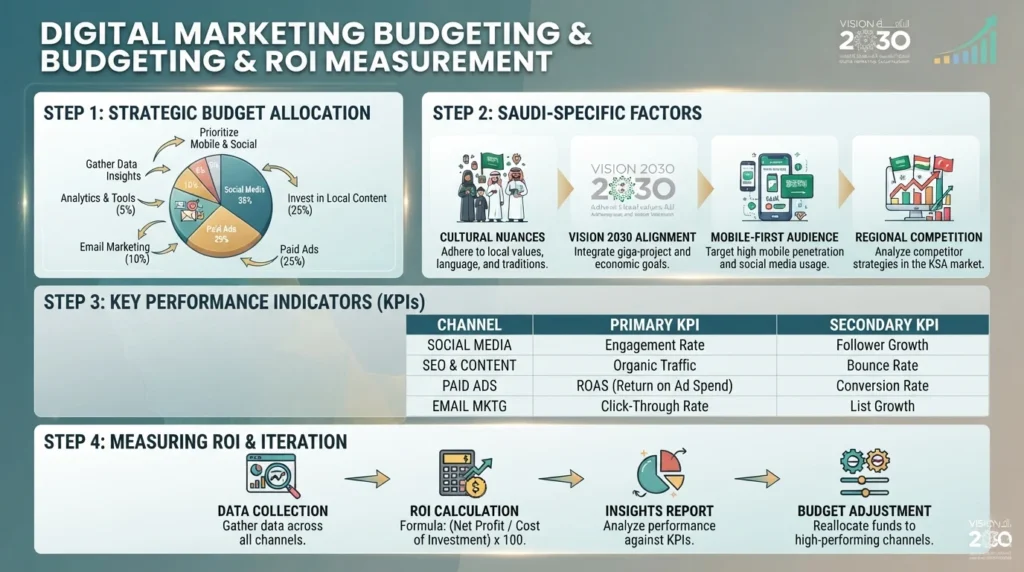
How you divide paid media and content depends on where your customers are and what you’re selling. In Saudi Arabia, Snapchat and TikTok often lead for consumer brands because of their reach and the way Saudis use them every day. Instagram remains important as a brand storefront. Google search captures people actively looking for a product or service, which makes it essential for many service businesses. SEO builds long-term visibility at a lower ongoing cost, and creators can accelerate trust and reach.
Start by concentrating budget on the two or three channels closest to your customers and goal, test them properly, then expand. For a closer look at what agency support for social media typically costs, see our guide to social media costs in Saudi Arabia.
Saudi-Specific Factors to Plan For
A marketing budget for an SME in KSA needs to reflect how the market works, not just generic advice.
VAT
Saudi Arabia applies VAT at 15 percent. Agency quotes and some tools are priced before VAT, so build it into your plan to avoid a shortfall.
Seasonal peaks
Ramadan, Eid, Founding Day, Saudi National Day, White Friday and Riyadh Season concentrate attention and competition. Advertising costs often rise during these periods, and creators book up early. Reserve a larger share of your annual budget for the moments that matter most to your customers.
Arabic and video production
Native Saudi Arabic copy and frequent short-form video are central to performing well in the Kingdom. Budget for ongoing production rather than a one-off shoot, because platforms like TikTok and Snapchat reward fresh content.
Licensing requirements
Creators who earn from advertising must be licensed, and discounts require a license from the Ministry of Commerce, with a limited number of discount days each year. Plan offers and creator campaigns with these rules in mind, since they affect timing and how you use your budget across the year.
Sample Budget Splits for Saudi SMEs
These illustrative splits show how priorities shift by business type. They’re starting points to adapt, not recommendations for every business.
| Budget line | Local service business | E-commerce store | Restaurant or café |
|---|---|---|---|
| Paid media | 40% (mostly Google search) | 45% (Snapchat, TikTok, Meta, Google) | 30% (Snapchat, Instagram, TikTok) |
| Content and production | 15% | 20% | 30% |
| Creators | 5% | 10% | 15% |
| Team or agency | 25% | 15% | 15% |
| Foundations, tools and contingency | 15% | 10% | 10% |
A service business leans on search because customers actively look for its services. An online store spreads paid media across discovery and search platforms. A restaurant invests more in content and creators because visuals and word of mouth drive visits.
Planning the Year
Rather than setting one annual figure and spending evenly, plan quarter by quarter. Map your seasonal peaks first, then allocate more budget to the months that matter most. A useful habit is to keep most of your spend on proven channels, a smaller share on channels you’re scaling, and a small portion for testing new ideas. Review every quarter and move money towards what’s working. Quarterly planning also makes it easier to align marketing with stock, staffing and cash flow, so campaigns don’t create demand the business can’t meet.
Keep a reserve for opportunities
Set aside a small contingency, perhaps a few percent of the annual budget, for opportunities you can’t predict: a campaign that’s outperforming and deserves more spend, a trend you can join quickly or a creator collaboration that suddenly becomes available. Without a reserve, good opportunities have to wait for next quarter.
An Example: Planning a Year for a Riyadh Boutique
Picture a women’s fashion boutique in Riyadh with an online store. The owner sets a goal of growing online sales significantly over twelve months and works back to a monthly budget. She allocates most of the paid media budget to Snapchat, TikTok and Instagram, with a smaller amount for Google search on brand and product terms. A monthly shoot provides fresh photos and short videos, and two licensed creators are booked each quarter. She reserves a larger share for Ramadan, Eid and White Friday, using one of her discount license periods for White Friday rather than spreading sales across the year. Every quarter, she reviews cost per order by channel and moves money towards the best performers. This illustrative scenario shows how a digital marketing budget in Saudi Arabia becomes a plan rather than a single number.
Measuring Return on Your Budget
A budget is only useful if you can see what it produces. Track a few key numbers: cost per lead, cost per new customer, return on ad spend for online stores and, over time, how much each customer is worth. Install proper tracking, use consistent attribution and ask new customers how they found you. Compare results against your goal-based plan each month, and adjust the split rather than simply increasing the total.
In-House Team or Agency?
The team line is one of the biggest decisions in any budget. An in-house marketer brings closeness to the brand and fast reactions, but one person rarely covers strategy, Arabic copywriting, video production, paid media and analytics equally well, and you’ll still need freelancers or tools. An agency retainer gives you a team with those skills, at the cost of some speed and the agency’s margin. Many Saudi SMEs start with an agency to build the system, then add an in-house coordinator for daily content and community management as they grow. Whichever you choose, budget for the full cost, including salaries, Saudi employment costs, tools and training for an in-house team.
Common Budgeting Mistakes
The same errors come up repeatedly in how much to spend on marketing decisions:
- Spending everything on ads with nothing left for content and production
- Spreading too thin across every platform instead of focusing on a few
- Ignoring seasonality and running out of budget before Ramadan or White Friday
- Forgetting VAT, creator fees and tools in the plan
- No tracking, making it impossible to know what worked
Plan the Money Before You Spend It
A strong digital marketing budget in Saudi Arabia starts with your goals, covers every building block, focuses spend on the channels closest to your customers, accounts for VAT, seasons and licensing, and measures return carefully. Plan quarter by quarter, test before scaling and keep adjusting. That way, every riyal has a job, and you can see which ones are doing it.
Build your budget with us.
mediaSine helps Saudi SMEs plan marketing budgets, choose channels and track return
Frequently Asked Questions
It depends on your goals, stage and competition. A common rule of thumb is a percentage of revenue, but a goal-based budget that works back from the number of customers you need is more reliable. Start with a focused test budget, measure results and scale what works.
Usually not. Ad spend is paid directly to platforms from your own accounts, while the agency charges for strategy, management and reporting. Keep the two separate in your budget.
For consumer brands, creators can be a meaningful share, especially around launches and seasonal campaigns. Service businesses often allocate less. Always work with licensed creators and agree deliverables in writing.
Review performance monthly and reallocate quarterly. Revisit the annual plan whenever your goals, products or market conditions change.
