
This article is general guidance for marketers, not legal advice. Regulations and fees can change, so confirm current requirements with the General Authority for Media Regulation or a qualified adviser before launching a campaign.
Saudi Arabia is one of the most active influencer markets in the region, and also one of the most regulated. Since 2022, creators who earn money from promotional content on social media have needed a government license to do it. For brands, that changes how creator campaigns are planned, contracted and published. Understanding the Mawthooq license isn’t just a creator’s concern; it’s part of running a compliant campaign in the Kingdom.
This guide explains what the license is, who needs it, the rules brands should know, and a practical checklist to run before any creator campaign goes live. If you’d like a partner to manage the process, see how MediaSine works as a social media agency in Saudi Arabia.
What Is the Mawthooq License?
“Mawthooq” (موثوق) means “trusted” in Arabic. The Mawthooq license is an official permit for individuals who provide advertising content on social media platforms in Saudi Arabia, including Instagram, Snapchat, TikTok, X, YouTube and Facebook. It came into force in October 2022 and turned influencer advertising into a regulated commercial activity.
The aim is to bring transparency and accountability to social media advertising: verified identities, registered accounts, clear disclosure and a regulator that can act when rules are broken.
Who issues it?
The license is issued by the General Authority for Media Regulation (GAMR), formerly known as the General Commission for Audiovisual Media (GCAM). The authority’s expanded name reflects a broader mandate covering media regulation across platforms. If you see older articles referring to GCAM, they’re describing the same scheme.
Who Needs a Mawthooq License?
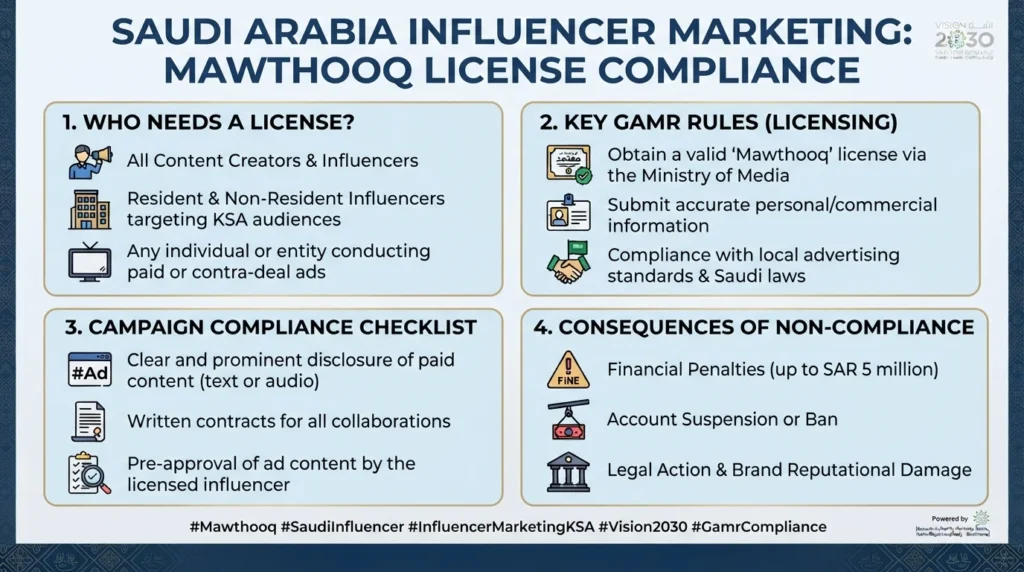
In broad terms, any individual who earns revenue from advertising or promotional content on social media in Saudi Arabia needs to be licensed. The route depends on who the creator is.
Saudi creators
Saudi nationals who advertise on social media need a Mawthooq license, including Saudis living outside the Kingdom who work with brands targeting Saudi audiences.
GCC, resident and foreign creators
Non-Saudi creators follow different tracks. Guidance published by law firms and regional agencies indicates that GCC nationals can obtain a commercial registration and an advertising license, while non-Saudi residents and foreign creators generally need to work through a licensed local advertising agency or under an investment license. In December 2024, GAMR set out conditions for resident foreigners and foreign investors, including an advertising or marketing agency license and specific company ownership requirements. Because these tracks are detailed and can change, confirm the right route for any non-Saudi creator before you contract them.
What isn’t usually covered
When the scheme launched, the regulator indicated that people promoting their own work on personal accounts, such as a designer sharing their designs, don’t need a license, while people promoting products or services commercially do. The line between personal promotion and advertising can be subtle, so check specific cases with the authority or an adviser.
Key Mawthooq License Rules Brands Should Know
These are the points most relevant to brands, based on the regulator’s published service information and recent legal and industry guides:
- Fee and validity: the license fee has been listed at SAR 15,000 for a three-year term.
- Age: license holders must be 18 or older.
- Registered accounts: ads may only run from the social media accounts registered to the license.
- Clear disclosure: paid or gifted promotional content must be clearly labelled as advertising, for example with #إعلان or #Ad.
- Compliance on request: license holders commit to removing advertising content when the authority requires it.
Note that gifts, free products, trips and other non-cash benefits are generally treated as advertising under Saudi rules, so “we only sent them a product” doesn’t remove the need for disclosure.
How long the process takes
Licensing isn’t instant. Published service information has listed a processing time of around 30 business days for new applications, and creators also need their accounts registered and verified. If you plan to work with a promising creator who isn’t yet licensed, factor that time into your campaign plan, or choose a creator who already holds a valid Mawthooq license for time-sensitive launches.
Why the Mawthooq License Matters for Brands?
It’s tempting to see licensing as the creator’s responsibility. In practice, brands share the risk. A campaign built around an unlicensed creator can be taken down, damage your reputation and expose your business to regulatory attention. Working only with licensed creators protects your campaign investment and signals to Saudi consumers that your brand plays by the rules.
Licensing has also changed the market. With fewer, more professional creators operating legally, rates and contracts have become more structured, and brands can expect clearer terms around deliverables, timelines and usage rights. Strong influencer marketing in Saudi Arabia now starts with compliance, not just reach.
A Brand-Side Checklist Before Any Creator Campaign
Run through these checks before contracting a creator and again before content goes live.
Verify the license
Ask every creator for their license details and check that the license is current and valid for the full campaign period. For non-Saudi creators, confirm which route they operate under and, where relevant, which licensed agency represents them.
Match the account
Confirm that the accounts you’re paying to post on are the accounts registered to the license. A creator with a valid license posting from an unregistered secondary account may still put your campaign at risk.
Build compliance into the contract
Your agreement should state that the creator holds a valid Mawthooq license, will post only from registered accounts, will disclose advertising clearly and will remove content if required by the authority. Include deliverables, approval steps, posting dates, usage rights and what happens if the license lapses mid-campaign.
Check sector rules
Some industries carry extra requirements on top of the creator license. Real estate advertising in Saudi Arabia, for example, has its own ad licensing through the Real Estate General Authority. Health, financial and other regulated products may also need approvals. Check whether your category has additional rules before briefing creators.
Keep records
Save license details, contracts, approved scripts, final posts and disclosure screenshots. If questions arise later, a clear record of what was agreed and published protects your brand.
Agree how disclosure will look
Don’t leave disclosure to chance. Agree in the brief exactly how each post will be labelled: a clear #إعلان or #Ad in the caption, an on-screen label in videos and Stories, or a verbal mention at the start of a Snapchat or TikTok video. Disclosure should be visible without tapping “more” or watching to the end. Clear labelling protects the creator, protects your brand and builds trust with audiences who increasingly expect transparency.
Common Mistakes Brands Make
A few errors come up repeatedly. Brands assume a creator with a large following must be licensed, without checking. They pay for posts on a creator’s secondary account that isn’t registered. They send products as “gifts” and expect organic-looking content with no disclosure. They reuse a regional creator for a Saudi-targeted campaign without confirming the creator’s route to operate legally. And they forget sector-specific approvals in categories such as real estate. Each of these is avoidable with a simple verification step before the contract is signed, which is why checking the Mawthooq license should be the first item on every creator brief.
Working With Creators From Outside the Kingdom
Many brands that operate across the region, including those based in Lebanon or Qatar, want to use creators they already work with in other markets. For campaigns aimed at Saudi audiences, that requires care. A creator who is popular in Beirut or Doha may not hold a Mawthooq license, and the route for non-Saudi creators is more involved than for Saudi nationals. The simplest approach is usually to work with licensed Saudi creators for Saudi-targeted content, or to manage non-Saudi creators through an appropriately licensed agency.
Planning Creator Campaigns in Saudi Arabia
Licensing adds steps, so build them into your timeline. Shortlist creators early, verify licenses before negotiating detailed terms and allow time for contract review and content approval. Brief creators on your brand, your message and the disclosure you expect, and give them room to speak in their own voice and dialect; Saudi audiences respond to content that feels natural, not scripted. Short-form video on TikTok and Snapchat is central to most creator campaigns in the Kingdom, and our guide to short-form video for Saudi audiences covers how to plan it.
Seasonal moments such as Ramadan, Founding Day, National Day and Riyadh Season concentrate demand for top creators, so book early for those periods and confirm licenses again before each campaign.
Measuring Creator Campaigns
Agree on success measures before the campaign starts. Useful measures include reach and views among Saudi audiences, engagement quality, clicks from tracked links, use of creator discount codes, and sales or leads during the campaign window. Ask creators to share platform insights after posting, and compare results across creators to inform future selection. Licensed, well-matched creators with smaller audiences often outperform larger accounts with scattered followings. Keep a simple scorecard for each creator you work with, covering results, reliability and how smoothly approvals went, so your shortlist improves with every campaign.
Frequently Asked Questions
The fee has been listed at SAR 15,000 for a three-year license. Fees and conditions can change, so confirm the current amount with the General Authority for Media Regulation.
Non-Saudi creators advertising to Saudi audiences generally need to operate through an approved route, such as a licensed local advertising agency or an investment license. Check the current requirements for each creator before contracting them.
Generally, yes. Saudi rules treat gifts, free products and trips as advertising benefits, so content created in return for them should be disclosed as advertising.
They’re the same regulator. The General Commission for Audiovisual Media (GCAM) became the General Authority for Media Regulation (GAMR), with a broader mandate. The Mawthooq license continues under GAMR.
Run Creator Campaigns With Confidence
The Mawthooq license has made influencer marketing in Saudi Arabia more professional and more transparent. For brands, that means verifying licenses, matching registered accounts, building compliance into contracts, checking sector rules and keeping good records. Do that, and creator campaigns become a reliable way to reach Saudi audiences rather than a regulatory risk.
Learn more about our Saudi Arabia services
Plan a compliant creator campaign.
mediaSine helps brands plan and manage creator campaigns in Saudi Arabia, from shortlisting licensed creators to briefing, approvals and reporting.
