
Saudi audiences can tell within a few words whether a caption was written for them. A post in stiff, formal Arabic reads like an announcement. A post translated from English reads like an import. A post in the wrong regional accent reads like a visitor trying too hard. Good Saudi dialect marketing content sounds like someone from the Kingdom talking to their friends, with the right level of warmth, respect and humour for the brand and the platform.
This guide explains when to use Saudi dialect, Modern Standard Arabic or the softer “white dialect”, how regional dialects differ, how tone should shift by platform, and the practical writing rules that separate native-sounding copy from translation. If you’d like a team to write it for you, see mediaSine’s Saudi social media management.
Why Saudi Dialect Marketing Content Outperforms Translated Copy?
Social media is personal. People open Snapchat, TikTok and Instagram to talk to friends and follow people they like, not to read corporate statements. Content that sounds like everyday speech fits that setting naturally, while formal or translated text stands out for the wrong reasons.
Translated copy also loses the things that make marketing work: rhythm, humour, cultural references and the small expressions that make a message feel familiar. A clever English pun rarely survives translation, and a literal Arabic version can sound awkward or even confusing. Writing Saudi social media content from scratch in a Saudi voice, rather than translating it, is one of the simplest ways to improve engagement.
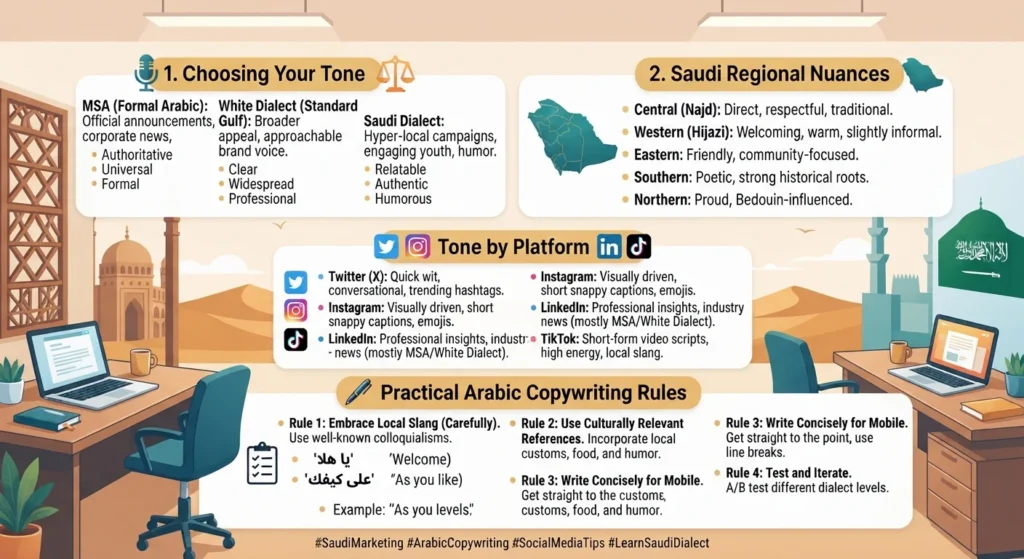
MSA, Saudi Dialect or “White Dialect”?
Arabic copywriting in Saudi Arabia involves a choice between registers, and each has its place.
Modern Standard Arabic
Modern Standard Arabic (فصحى) is the formal written language used in official communication, news, education and legal text. It’s clear, respectful and understood across the Arab world. On social media, it suits government entities, formal announcements, financial services, healthcare and B2B content, especially on LinkedIn and X. For everyday consumer content, it can feel distant.
Saudi dialect
Saudi colloquial Arabic is how people actually speak and message. It brings warmth, humour and immediacy, and it’s the natural choice for consumer brands on Snapchat, TikTok and Instagram. The risk is overdoing it: heavy slang can feel forced if it doesn’t match your brand, and very local expressions may not travel across regions.
The “white dialect” middle ground
Many brands and media outlets use what’s often called “white dialect” (اللهجة البيضاء): a softened, widely understood colloquial Arabic that feels conversational without leaning heavily on one region’s slang. For national campaigns aimed at audiences across the Kingdom, it’s often the safest choice, combining the warmth of dialect with broad clarity.
Regional Dialects Inside the Kingdom
Saudi Arabia isn’t linguistically uniform. Najdi Arabic is associated with the central region around Riyadh. Hejazi Arabic is associated with the western region, including Jeddah, Makkah and Madinah. The Eastern Province shares features with wider Gulf Arabic, and the south has its own distinct varieties. Small differences in everyday words can signal where a speaker is from. For example, “what” is commonly وش in Najdi speech and إيش in Hejazi speech.
For most brands, the practical rule is simple. If you’re targeting one city or region, a touch of that region’s voice can build closeness. If you’re targeting the whole Kingdom, stay closer to white dialect and avoid expressions strongly tied to one area. When in doubt, have writers from your target region review the copy.
Matching Tone to the Platform
The same brand can sound slightly different on each platform, and it should. A useful starting point:
- Snapchat: the most casual and personal, close to how friends talk, short and spontaneous
- TikTok: conversational and energetic, often spoken rather than written, with humour where it fits
- Instagram: warm and polished, usually white dialect, with clear calls to action
- X: concise and often more formal, suited to news, announcements and timely conversation
- LinkedIn: professional, often Modern Standard Arabic or English, for B2B and employer content
Spoken content matters as much as written captions. On TikTok and Snapchat, the voiceover or the person speaking to camera carries the message, so cast presenters and creators whose natural voice matches your target audience.
The same applies to creators. When a licensed Saudi creator presents your product, let them use their own natural phrasing within your key messages. Over-scripting a creator in formal or translated Arabic removes the authenticity you hired them for.
Practical Writing Rules for Arabic Copywriting in Saudi Arabia
Beyond register and region, a handful of details separate native-sounding Arabic copywriting in Saudi Arabia from copy that feels translated.
Decide how you address your audience
Arabic verbs and pronouns change by gender and number. Addressing “you” in the masculine singular, feminine singular or plural sends different signals. Many brands use plural forms to speak to everyone, or tailor copy by audience when targeting ads. Decide your default in a style guide and apply it consistently, so captions, ads and customer service replies all speak to people in the same way.
Be consistent with numbers and scripts
Saudi audiences see both Western digits (3) and Arabic-Indic digits (٣), as well as English brand and product names mixed into Arabic sentences. Choose a convention for prices, dates and phone numbers, and check that mixed Arabic and English text displays correctly from right to left, especially around punctuation.
Use Arabic hashtags and searchable words
People search social platforms in Arabic. Use relevant Arabic hashtags and include the words your audience would type when looking for your product or service, accounting for common spelling variations.
Handle brand names thoughtfully
Decide whether your brand name appears in Latin script, Arabic script or both, and keep it consistent. If you use an Arabic version, make sure it reads naturally and doesn’t create unintended meanings.
Use humour and religious expressions with care
Humour lands well when it feels local and kind, and badly when it relies on stereotypes or sensitive topics. Everyday expressions with religious roots are part of normal speech, but avoid attaching sacred phrases or imagery to commercial messages in ways that could seem disrespectful. If you’re unsure, leave it out or ask a native reviewer before publishing.
Common mistakes to avoid
Several errors show up repeatedly in Saudi dialect marketing content produced outside the Kingdom. Writers mix Levantine or Egyptian expressions into supposedly Saudi copy. Teams translate English slogans word for word, producing phrases no Saudi would say. Brands switch between formal and colloquial Arabic within a single post, which feels disjointed. Others lean on slang so heavily that the brand sounds like it’s imitating its audience rather than speaking to it. And many forget that captions are only half the message; a voiceover in the wrong accent can undo a perfectly written caption.
Writing for Saudi Occasions
Seasonal content is where tone matters most. Ramadan messages should feel warm, reflective and generous rather than purely promotional, with greetings such as رمضان كريم used sincerely. Eid content can be joyful and celebratory. Founding Day on 22 February and Saudi National Day on 23 September are distinct occasions with different meanings, so avoid treating them as interchangeable. Founding Day focuses on the Kingdom’s historical roots, while National Day marks the unification of the modern state. Plan Arabic copy for these moments first, then adapt into English if needed.
An Example: From Idea to Saudi Copy
Here’s how one simple message might look in different registers. The idea: “Our new summer menu is here. Come try it this weekend.”
In Modern Standard Arabic: قائمتنا الصيفية الجديدة متوفرة الآن. زورونا في عطلة نهاية الأسبوع وجربوها. It’s clear and correct, but it reads like a formal notice.
In a conversational Saudi register: منيو الصيف الجديد وصل! تعالوا جربوه هالويكند 😋. It’s shorter, warmer and sounds like something a friend would send. For a café on Instagram or Snapchat, the second version is usually the better fit. For a hotel’s official LinkedIn page, the first might be more appropriate.
This kind of side-by-side comparison is a useful exercise for any team. Write key messages in two registers, test them, and let the results guide your style guide.
A Workflow for Saudi Copy
Reliable Saudi dialect marketing content comes from process as much as talent. Brief the idea in plain terms, including the audience, platform, goal and tone, rather than handing over English copy to translate. Have a native Saudi writer create the Arabic from scratch. Add a second native review for tone, accuracy and cultural fit. Then design visuals around the final Arabic text, so layouts work right to left from the start. We’ll cover that design side in a dedicated guide to Arabic social graphics, and mediaSine’s content creation team builds this workflow into monthly planning.
Testing helps too. Run two caption styles on the same post or ad, one in white dialect and one with a stronger regional or more formal voice, and compare engagement and click-through. Over a few months, the data will show which voice your audience prefers for which kinds of content.
Finally, keep a living style guide: your default register, how you address the audience, approved terms and spellings, hashtags, and examples of copy that worked. It keeps every writer and creator consistent as your content scales.
Frequently Asked Questions
No. Saudi dialect content can range from very casual to polished and warm. Match the level of informality to your brand, your audience and the platform. Many brands use white dialect as a balanced default.
Yes, for formal announcements, government and institutional brands, financial and healthcare services, and professional content on LinkedIn or X. It signals seriousness and is understood everywhere.
Experienced Arabic writers from other countries can produce good content, but a native Saudi writer or reviewer is the best safeguard against phrasing that sounds foreign or regional in the wrong way.
Only if you’re targeting regions separately. For national campaigns, a widely understood white dialect usually works best. For city-specific campaigns, a light regional touch can help.
Sound Like You Belong
The best Saudi dialect marketing content makes a brand sound like it belongs in the Kingdom. Choose the right register for each message, respect regional differences, adapt tone to each platform, get the small details right and write for Saudi occasions with care. Build a workflow around native writers and a clear style guide, and your copy will feel local from the first word.
Get Saudi-native content.
mediaSine creates social media copy and content for Saudi audiences, written to sound natural on every platform.
