
Saudi Arabia is one of the few markets where locally built e-commerce platforms are a serious first choice rather than a budget compromise. Salla and Zid power a large share of Saudi online stores, while Shopify remains the global heavyweight. Most comparisons focus on setup and features. This guide adds what many leave out: how each platform affects your marketing, tracking and SEO once the store is live. Whether you’re weighing Salla vs Zid or considering Shopify instead, the right answer depends on where you sell, how you plan to grow and how you’ll bring customers to the store.
If you’d like help building or migrating your store, see mediaSine’s e-commerce development services.
The Three Platforms in Brief
Salla
Salla is a Saudi-built platform founded in 2016, designed around the local market. Arabic is native, and local payments, shipping and e-invoicing are built into the core experience. It’s widely used by Saudi merchants of all sizes, from small sellers to established brands.
Zid
Zid is another Saudi platform with a similar focus: Arabic-first stores, local payment methods, shipping integrations and tools for Saudi merchants. Its feature set overlaps heavily with Salla’s, so the choice between them often comes down to specific plans, apps and support preferences.
Shopify
Shopify is a global hosted platform with the largest app ecosystem in e-commerce, strong customisation options and excellent tools for selling across multiple countries. In Saudi Arabia, it can do almost everything the local platforms do, but more of it is added through apps and third-party integrations.
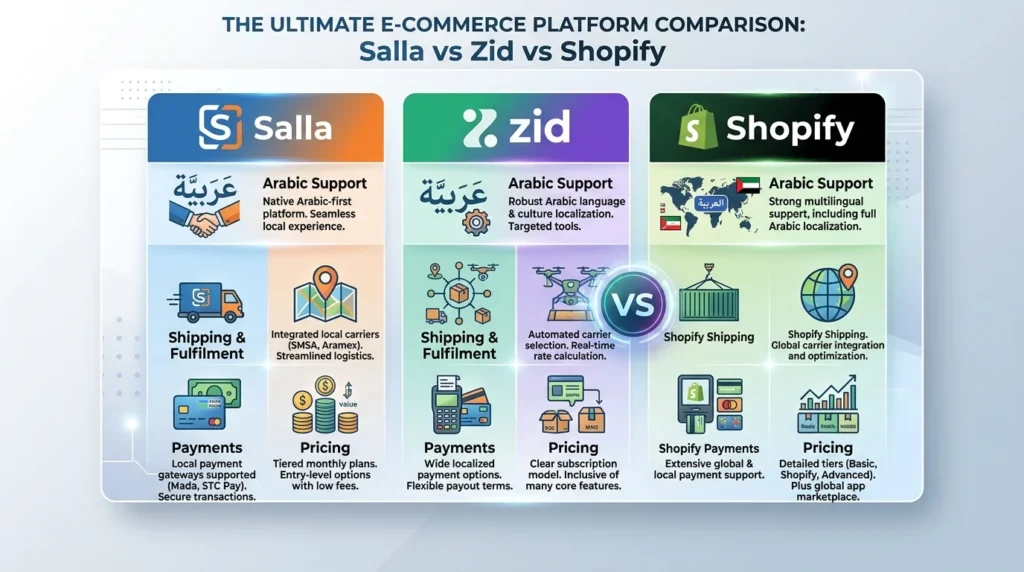
Salla vs Zid vs Shopify at a Glance
| Salla | Zid | Shopify | |
|---|---|---|---|
| Built for | Saudi market | Saudi market | Global |
| Arabic and RTL | Native | Native | Theme and app dependent |
| mada, STC Pay, BNPL | Built in | Built in | Via third-party gateways |
| Local shipping and COD | Built in | Built in | Via apps or integrations |
| App ecosystem | Growing, regional | Growing, regional | Very large, global |
| Multi-country selling | More limited | More limited | Strong |
| Setup effort for KSA | Low | Low | Moderate |
Payments: Where the Platforms Differ Most
Payments are the single biggest practical difference. On Salla and Zid, Saudi payment methods such as mada, STC Pay, Apple Pay and buy-now-pay-later options like Tabby and Tamara are part of the core setup, so merchants can activate them with little technical work.
On Shopify, Shopify’s own payment processing isn’t available to Saudi merchants, according to multiple 2026 platform comparisons. Stores connect third-party gateways such as Moyasar, HyperPay, PayTabs or Tap Payments, which support mada. That works well when set up properly, but it adds configuration and testing, and Shopify typically charges its own transaction fee on top of the gateway’s fees when Shopify Payments isn’t used. For a store with steady sales, that fee is worth including in your cost comparison.
Shipping, Cash on Delivery and E-invoicing
Saudi shoppers expect reliable delivery, and cash on delivery still matters in some categories and regions. Salla and Zid are built with local shipping companies and COD workflows in mind. Both also support ZATCA e-invoicing requirements, which saves Saudi merchants significant compliance work. Shopify can handle all of these, but typically through apps or custom integrations, so check that the specific couriers and invoicing tools you need are supported before you commit.
The Arabic Experience
Salla and Zid offer native Arabic admin panels and storefronts, which matters if your team works in Arabic day to day. Shopify supports Arabic storefronts and right-to-left layouts, but quality varies by theme and may rely on apps. Whatever you choose, test product pages, filters, checkout and order emails in Arabic on mobile before launch.
The Marketing Angle: Tracking and Ads
Your platform shapes how well you can measure and optimise paid campaigns, which in Saudi Arabia often means Snapchat, TikTok, Meta and Google.
Pixels and conversion tracking
All three platforms support the main advertising pixels in some form. The important question is whether purchases are tracked accurately, once each and with the correct value in SAR, and whether server-side tracking is available to reduce data loss. Shopify’s app ecosystem generally offers the most options for advanced, server-side tracking; Salla and Zid provide built-in integrations that are simpler to set up. Test every pixel with a real purchase before spending on ads; our guide to Snapchat ads in Saudi Arabia explains why accurate conversion data matters.
Promotions and discount codes
All three support discount codes, automatic discounts and promotional pricing. Remember that announcing discounts in Saudi Arabia requires a Ministry of Commerce discount license, regardless of platform, so plan sales campaigns around your license periods.
The SEO Angle
Choosing the best ecommerce platform in Saudi Arabia for organic search depends on how much control you need. Check whether each platform lets you edit page titles and descriptions for products and categories, control URL structure, manage redirects, add structured data, publish blog content and run proper Arabic and English versions with correct language signals. Site speed on mobile matters too, especially with large product images and heavy apps that add scripts to every page.
Shopify generally offers the deepest SEO tooling through apps, while Salla and Zid cover the essentials with less configuration. For stores that plan to invest heavily in content and Arabic SEO, it’s worth checking each platform’s current SEO features in detail. Our guide to Arabic keyword research explains how Saudis search, which should shape your category and product pages whichever platform you choose.
Costs Over Time
Compare total cost over two or three years, not just the monthly plan. For Salla and Zid, consider the plan tier you’ll need, any per-transaction fees on your plan, payment processing rates and paid apps. For Shopify, include the plan, the platform transaction fee when using third-party gateways, gateway processing fees, theme and app subscriptions and any development needed for local integrations. Plans and fees change regularly, so check current pricing directly with each platform before deciding. A simple spreadsheet that models your expected monthly orders and average order value across each option will show the real difference quickly.
Salla vs Zid: Choosing Between the Saudi Platforms
For many merchants, the real decision is Salla vs Zid. Both are built for the Saudi market, both include local payments and shipping, and both support Arabic natively. The differences tend to lie in the details: the features included in each plan, transaction fees, available apps and themes, admin experience and the quality of support you receive.
The most reliable way to decide is to trial both. List the features you can’t do without, such as specific payment options, shipping partners, loyalty tools or marketing integrations, then check how each platform handles them on the plan you’d actually use. Ask other merchants in your category about their experience with support and reliability during peak seasons like White Friday and Ramadan. In practice, many merchants find that Salla vs Zid matters less than how well they use whichever platform they choose.
Questions to Ask Before You Decide
Whether you’re settling Salla vs Zid or deciding between a Saudi platform and Shopify, the same questions bring clarity:
- Where will you sell in the next two to three years: only Saudi Arabia, or across the Gulf and beyond?
- Which payment and shipping options are essential for your customers?
- Who will manage the store, and how comfortable are they with apps and integrations?
- How much will you invest in ads and SEO, and what tracking do you need?
- What will it cost in total at your expected sales volume?
Write the answers down before you start free trials. They turn a long feature comparison into a short list of deal-breakers, and they make the Salla vs Zid question far easier to settle when both platforms look similar on paper.
Salla vs Shopify: Which Fits Which Store?
When the comparison is Salla vs Shopify, or Zid vs Shopify, the deciding factor is usually where you sell and how complex your store is.
Choose Salla or Zid if
You sell mainly in Saudi Arabia, want mada, BNPL, COD and e-invoicing working from day one, have a small team without dedicated technical support, and prefer to focus on products and marketing rather than integrations.
Choose Shopify if
You sell across several countries, need deep customisation or advanced integrations, want the widest range of apps and tracking tools, or already run Shopify elsewhere and want one platform for all markets, with the budget and technical support to configure Saudi payments properly.
An example
Picture two brands. A Riyadh-based perfume label selling only within the Kingdom, with a small team, launches quickly on Salla or Zid and spends its effort on Snapchat and creator campaigns. A Lebanese fashion brand already selling across the Gulf and Europe on Shopify adds Saudi payments through a local gateway, keeping one store for every market. Both choices make sense for their own situations and growth plans. These are illustrative scenarios, not client examples.
Selling in Qatar Too?
If you also sell in Qatar, the decision set changes, because Salla and Zid are primarily focused on Saudi Arabia. Our guide to Shopify vs WooCommerce for Qatar stores covers that market in detail.
Choose the Platform That Matches Your Market
The Salla vs Zid decision is usually about plan details and support, while the bigger question is whether a Saudi-native platform or Shopify fits your business. For Saudi-only stores, Salla and Zid offer the fastest route to local payments, shipping and compliance. For multi-market brands or complex stores, Shopify’s flexibility can justify the extra setup. Check payments, tracking, SEO and total cost before you commit, and you’ll launch on a platform that supports your marketing rather than limiting it.
Get a platform recommendation.
mediaSine helps brands choose, build and market online stores in Saudi Arabia.
Frequently Asked Questions
For many small stores, both will work well. Compare the plan features, fees, apps and support you’d actually use, and trial both if you can.
Yes, through third-party gateways such as Moyasar, HyperPay, PayTabs or Tap Payments, which support mada. It requires setup and testing rather than working out of the box.
All three can rank well when set up properly. Shopify offers the deepest SEO tooling through apps, while Salla and Zid cover the essentials more simply. Content quality and Arabic keyword targeting usually matter more than the platform itself.
Yes, but migrations require careful handling of products, customers, URLs and redirects to protect SEO and sales. Choosing well at the start saves effort, cost and lost rankings later.
