
Translate your English keyword list into Arabic, plug it into a tool, and you’ll miss a large share of how Saudis actually search. One person types أفضل مطعم في الرياض; another types افضل مطعم بالرياض; a third searches for منيو rather than قائمة الطعام. Some write in Arabic script, some mix in English words, and some switch keyboards halfway through. Good Arabic keyword research starts by accepting that variety, then turning it into a clear map of which searches matter and which page should answer them.
This guide explains why Arabic needs its own research process, the main sources of variation in Saudi searches, a step-by-step method, the tools that help, and how to apply your findings without creating duplicate pages. If you’d like expert support, see mediaSine’s SEO services.
Why Arabic Keyword Research Needs Its Own Process?
Arabic works differently from English in ways that directly affect search. Words are built from roots and patterns, and prefixes and suffixes attach directly to words: the definite article ال, the conjunction و and possessive endings all change the string a search engine sees. A single concept can appear in several forms depending on grammar and context.
Then there’s spelling. Several common letters have more than one accepted or habitual written form, and many users don’t type them consistently. On top of that, Saudi users move between Modern Standard Arabic, Saudi dialect and English loanwords. A translated keyword list captures only one version of each idea, which is why Arabic SEO in Saudi Arabia needs native research rather than translation.
The Main Sources of Variation in Saudi Searches
Understanding Saudi search behaviour starts with the patterns that create keyword variants. Most fall into five groups.
Spelling variants
Many searchers don’t type hamza forms, so أفضل often appears as افضل. Taa marbuta is frequently typed as haa, so قهوة becomes قهوه. Final alif maqsura and yaa are often swapped, so مستشفى may appear as مستشفي. Search engines handle some of these variations as equivalent, but not always, so check the results for each important variant rather than assuming.
Prepositions and joined words
Searchers vary how they connect words: في الرياض versus بالرياض, or adding and dropping ال. These small changes can shift results and volumes, especially for local searches.
Dialect versus Modern Standard Arabic
Everyday Saudi terms often differ from formal Arabic. People commonly search for جوال rather than هاتف محمول when looking for a mobile phone. Your research should capture the words customers actually use, not just the formally correct ones.
English loanwords written in Arabic
Many product and service terms arrive as English words written in Arabic script, such as منيو for menu or أونلاين for online. These transliterated terms can carry meaningful search demand alongside their Arabic equivalents.
Regional vocabulary
The Kingdom is large, and everyday vocabulary can vary between regions such as Najd, the Hejaz and the Eastern Province. For national campaigns, focus on widely used terms; for city-specific pages, ask native reviewers from that region whether local words carry meaningful search demand.
Latin script, Arabizi and keyboard slips
Some Saudi users search in English, write Arabic words in Latin letters, or type an Arabic query while their keyboard is still set to English, producing strings of Latin characters. Brand names in particular are searched in both scripts. Don’t build pages for every typo, but do make sure your brand and key terms are covered in both Arabic and Latin forms.
A Step-by-Step Method for Arabic Keyword Research
A reliable process turns all that variety into a usable plan.
Step 1: Start with real customer language
Before opening any tool, gather the words customers actually use. Ask sales and customer service teams how people describe your products, review WhatsApp messages, reviews and social comments, and note the terms that come up repeatedly. This native seed list is more valuable than any translation.
Step 2: Expand with Google’s own suggestions
Type your seed terms into Google in Arabic, with your location and language set to Saudi Arabia. Autocomplete suggestions, “People also ask” questions and related searches show the phrasing real users choose. Repeat with spelling variants and dialect terms to uncover additional patterns.
Step 3: Add volume and competition data
Use Google Keyword Planner with Saudi Arabia as the location and Arabic as the language, alongside a third-party tool that supports Saudi data. Compare variants side by side to see which spellings and phrasings carry the most demand. Treat volumes as estimates, especially for low-volume terms, and look at trends over time with Google Trends. A variant with modest volume but very clear buying intent can be worth more than a high-volume informational phrase.
Step 4: Look at social and video search
Many younger Saudis search on TikTok, YouTube and Snapchat as well as Google. Check how people phrase searches and hashtags on these platforms; it often reveals dialect terms and question formats that standard tools miss.
Step 5: Study the results pages
For each important keyword and variant, look at what actually ranks. Are the results product pages, service pages, articles, maps or videos? Do different spellings show the same results? If they do, the variants can usually be targeted by one page. If results differ significantly, the intent may be different too.
Step 6: Group variants and map them to pages
Cluster keywords that share the same intent, including all their spelling and phrasing variants, and assign each cluster to a single page. Choose a primary phrasing for the title and main heading, and use the important variants naturally in the body. This step is where good Arabic keyword research prevents keyword cannibalisation, because you won’t end up with separate pages competing for افضل and أفضل.
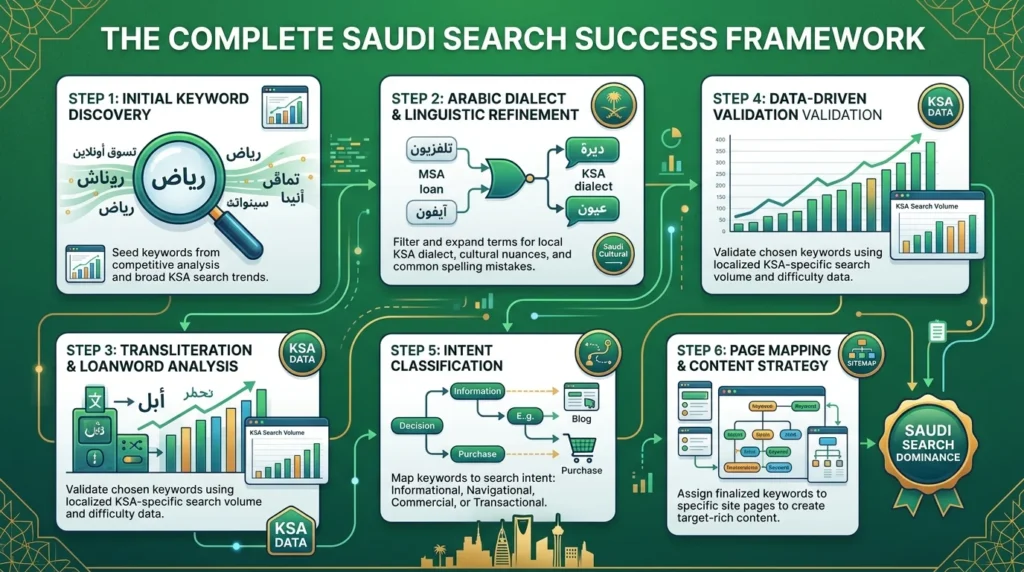
An Example: Mapping Keywords for a Riyadh Café
Picture a specialty coffee shop in Riyadh building its first Arabic pages. Its seed list, gathered from staff and customer messages, includes قهوة مختصة, كافيه, and كوفي alongside the English “specialty coffee”. Google suggestions add phrases such as افضل كافيه في الرياض and كافيهات الرياض, plus variants with and without hamza and ال. Results pages show that most of these variants return similar local results, so they’re grouped into one cluster mapped to the café’s main Arabic location page. Searches for its menu, including منيو and قائمة, go to a separate menu page, because the intent is different. Brand searches in Arabic and Latin script both point to the homepage. The result is a small, clear map: a handful of pages, each owning one intent and all its variants, instead of dozens of thin pages chasing every spelling. This is an illustrative scenario, not a client example.
Tools That Help
No single tool covers Arabic perfectly, so combine sources. Google Keyword Planner gives volume ranges for Saudi Arabia. Google Search Console shows the actual queries, including variants, that already bring impressions to your site, often the richest data source once a site is live. Google Trends compares interest across terms and regions within the Kingdom. Third-party SEO platforms with Saudi databases add competitor insights and keyword difficulty. And native Saudi reviewers remain essential for judging whether a phrase sounds natural.
Applying Your Research On-Page
Research only pays off when it shapes your pages. Use the primary phrasing in the page title, main heading and opening paragraph. Work important variants and dialect terms naturally into subheadings and body copy, rather than repeating the same word mechanically. Write Arabic content natively, not as a translation of an English page, so it reads well and covers related terms people expect to find.
For URLs, you can use Arabic or transliterated slugs. Arabic URLs are readable to Arabic users but often display as long encoded strings when shared, while short Latin slugs are easier to share. Either can work; consistency matters more. If your site has Arabic and English versions, use hreflang tags to tell Google which version serves which audience.
Arabic or English First?
Arabic keyword research also helps you decide where to invest. In some categories, Arabic searches dominate; in others, especially technical, B2B or luxury products, English searches may carry more weight even in Saudi Arabia. Research both before deciding which language to prioritise.
Measuring and Refining
Once your pages are live, Search Console becomes your best research tool. Review which queries bring impressions and clicks, which variants you rank for and where you appear on page two or three. Add variants that are gaining impressions to your content, and refine pages where rankings stall. Revisit your keyword map every few months, because language, products and search habits keep evolving. New slang, new product names and seasonal searches around Ramadan, National Day or White Friday can all create fresh opportunities worth adding to existing pages.
Common mistakes in Arabic keyword research
The most frequent errors are translating English keywords directly, ignoring spelling variants, relying on formal Arabic when customers use dialect, creating separate pages for each spelling, and trusting tool volumes without checking the results pages. Avoiding these alone puts you ahead of many competitors in the Saudi market.
Search the Way Saudis Search
Effective Arabic keyword research means starting with real customer language, accounting for spelling variants, dialect and loanwords, validating with data and results pages, and mapping each group of variants to a single strong page. Combine tools with native judgement, measure what happens once pages go live, and keep refining. Do that, and your site will be found by Saudi customers however they choose to type their searches.
Get an Arabic SEO audit
mediaSine can review how your site performs for Saudi Arabic searches and build a keyword map for your market
Frequently Asked Questions
Yes. Dialect terms, loanwords and local phrasing differ across the Arab world, and search volumes vary by country. Research Saudi searches specifically, with location set to Saudi Arabia, rather than reusing research from Egypt or the Levant.
Sometimes. Google often understands common variants, but results can still differ. Check the results pages for your most important variants before deciding whether one page can target them all.
Usually not as separate pages. Include important transliterated terms and loanwords within the relevant page, and make sure brand names are covered in both Arabic and Latin script.
Review it every few months, and whenever you launch new products or services. Search Console data will reveal new variants and opportunities over time.
