
Choosing an e-commerce platform is one of those decisions that’s easy to make and expensive to undo. Pick the wrong one and you may find yourself fighting payment integrations, paying for apps you didn’t expect or rebuilding the store two years later. For most retailers in Doha, the shortlist comes down to two names. The Shopify vs WooCommerce in Qatar decision isn’t about which platform is better in general; it’s about which one fits your products, your team, your payment and delivery needs, and your plans for growth.
This guide compares the two on the issues that matter most for a Qatar store: payments, Arabic and bilingual support, shipping, costs over time, flexibility and SEO. If you’d like help building your store, see mediaSine’s e-commerce development services.
Shopify and WooCommerce in a Nutshell
Shopify is a hosted platform. You pay a monthly subscription, and Shopify handles hosting, security, updates and core infrastructure. You build your store with themes and extend it with apps from its app store. It’s designed to get a store running quickly with minimal technical work.
WooCommerce is a free, open-source plugin that turns a WordPress website into an online store. You host it yourself, choose your own themes and plugins, and control every part of the site and its data. That flexibility comes with responsibility: hosting, updates, security and performance are up to you or your developer.
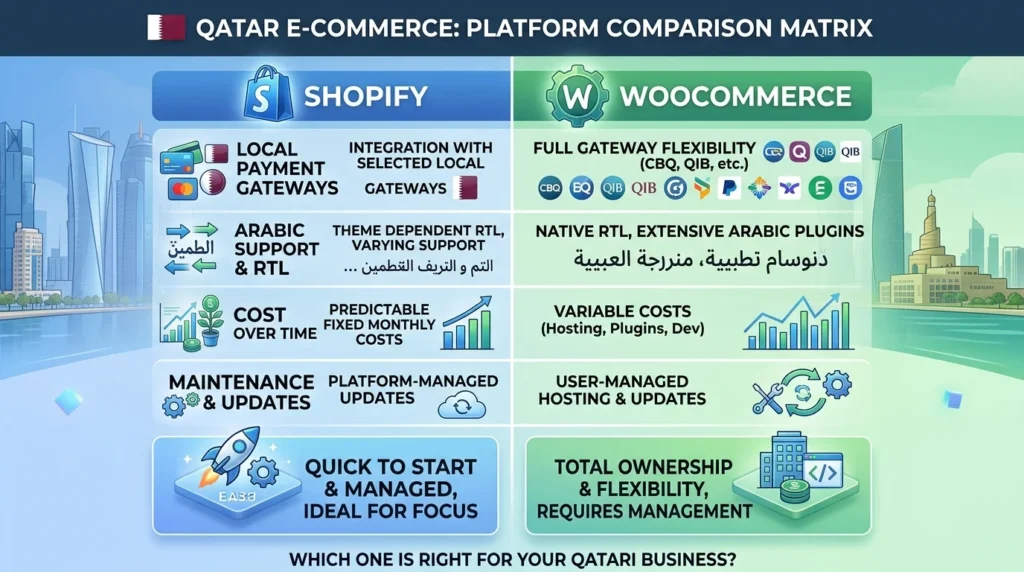
Shopify vs WooCommerce in Qatar at a Glance
| Shopify | WooCommerce | |
|---|---|---|
| Setup | Fast, minimal technical work | Needs hosting, WordPress and configuration |
| Hosting and security | Included and managed | Your responsibility |
| Costs | Monthly plan, plus apps and themes | Free plugin, plus hosting, plugins and development |
| Flexibility | High within Shopify’s framework | Very high, full control of code and data |
| Arabic and RTL | Supported through themes and translation features | Supported through RTL themes and multilingual plugins |
| Local payments | Via third-party Qatar gateways | Via third-party Qatar gateways |
| Best for | Brands wanting speed and low maintenance | Brands wanting control, content-led sites or custom features |
Payments in Qatar
Payments are often the deciding factor for an online store in Qatar. Customers expect to pay with local debit cards as well as international credit cards and wallets, and the gateway you choose needs to work smoothly with your platform.
The good news is that several gateways serving Qatar offer ready-made integrations for both platforms. Providers such as SADAD, SkipCash, Tap Payments and MyFatoorah publish plugins or apps for Shopify and WooCommerce. SADAD’s Shopify app, for example, supports local NAPS and Himyan debit cards alongside Visa, Mastercard and Amex, with an Arabic and English checkout. Bank-led options such as QNB’s QPay and gateways like Dibsy are also widely used.
On Shopify, check whether Shopify’s own payment processing is available for your business; where it isn’t, you’ll rely on a third-party gateway, and Shopify may charge an additional transaction fee on top of the gateway’s fees, depending on your plan. On WooCommerce, there’s no platform transaction fee, but you’ll install and maintain the gateway plugin yourself. In both cases, compare gateway fees, settlement times, refund handling and supported payment methods before committing, and ask each provider how long merchant onboarding takes, since approval can affect your launch date. Many Qatar stores also offer cash on delivery, which both platforms support.
Test the checkout before launch
Whatever you choose, run real test transactions with local debit cards, international cards and any wallets you plan to accept, on both mobile and desktop, in Arabic and English. Check confirmation emails, refunds and how quickly funds settle into your account. A checkout that fails for one common card type can quietly cost a large share of your sales.
Arabic, RTL and Bilingual Stores
Most stores in Qatar need Arabic and English. Shopify supports multiple languages and offers themes with right-to-left support, though the quality of Arabic layouts varies by theme, so test carefully before choosing. WooCommerce works with RTL-ready WordPress themes and established multilingual plugins, giving fine control over translations and URLs, but it requires more configuration.
On either platform, write Arabic content natively rather than relying on machine translation, test product pages, filters and checkout in Arabic on mobile, and make sure both language versions are complete, including product descriptions, size guides and policies.
Shipping and Delivery
Qatar shoppers increasingly expect fast delivery, often same-day or next-day within Doha. Both platforms let you set delivery zones, rates and options such as local pickup. For courier integrations, check which apps or plugins connect to the providers you plan to use; some gateway plugins, such as MyFatoorah’s WooCommerce plugin, also include shipping integrations with international couriers. If you use your own drivers or a local delivery partner, make sure orders can flow into their system easily.
Costs Over Time
Compare total cost of ownership over two or three years, not just the setup price. With Shopify, budget for the monthly plan, premium theme, paid apps and any transaction fees. With WooCommerce, budget for hosting, premium plugins and themes, developer time, security and ongoing maintenance.
Shopify’s costs are more predictable; WooCommerce’s can be lower or higher depending on how much customisation and maintenance you need. A simple store can be very affordable on either. A complex store with many integrations may favour WooCommerce’s flexibility or Shopify’s managed stability, depending on your team.
Flexibility, Control and Scale
WooCommerce gives you complete control over code, data and hosting, making it ideal for custom features, complex product configurations or businesses that already run a content-rich WordPress site. Shopify offers less low-level control but handles traffic spikes, security and updates for you, which matters during busy periods like Ramadan, National Day or White Friday sales. Both can scale; the real question is whether you prefer to manage the infrastructure yourself or pay to have it managed.
Planning for peak seasons
Qatar’s retail calendar has sharp peaks around Ramadan, Eid, National Day and year-end sales. Whichever platform you choose, test how the store handles larger traffic, set up promotions and discount codes in advance, and make sure your hosting or plan can cope. On WooCommerce in particular, a busy sale is the wrong moment to discover that your hosting can’t keep up.
SEO and Marketing
Both platforms can rank well when set up properly. WooCommerce, built on WordPress, offers strong content and SEO flexibility, which suits brands that publish guides and blog content. Shopify covers the essentials well and has a large app ecosystem for reviews, email marketing and promotions. On either platform, focus on fast pages, clean product and category structure, unique descriptions and proper Arabic and English versions.
Support and Maintenance
Think about who will look after the store once it’s live. On Shopify, platform updates and security are handled for you, so ongoing work focuses on products, content, apps and marketing. On WooCommerce, someone needs to update WordPress, plugins and themes, monitor security, manage backups and keep the site fast. If you don’t have that capability in-house, budget for a maintenance plan with a developer or agency. In the Shopify vs WooCommerce in Qatar decision, the availability of reliable local support is often as important as the platform’s features.
Which E-commerce Platform in Qatar Should You Choose?
The right e-commerce platform in Qatar depends on your situation.
Choose Shopify if
You want to launch quickly, prefer not to manage hosting or security, have a relatively standard product catalogue and value predictable monthly costs. Shopify suits fashion, beauty, gifts and many consumer brands that want to focus on marketing rather than maintenance.
Choose WooCommerce if
You need custom features or complex products, already have a WordPress site, want full ownership of your data and hosting, or plan significant content marketing alongside your store. It suits businesses with access to reliable development support, whether in-house or through an agency.
An example
Picture two Doha businesses. A new abaya label with a few dozen products wants to launch before Ramadan, has no in-house developer and plans to focus on Instagram marketing; Shopify is the natural fit. A home appliance retailer with hundreds of products, complex specifications, an existing WordPress site and a content strategy built on buying guides may get more from WooCommerce. These are illustrative scenarios, not client examples.
Common Mistakes When Choosing a Platform
Several mistakes come up repeatedly. Businesses choose a platform before checking whether their preferred gateway and couriers integrate properly. They pick a theme that looks good in English but breaks in Arabic. They compare only the setup price and ignore apps, plugins and maintenance over time. They underestimate how much product data, photography and content the store needs. And they choose WooCommerce without anyone to maintain it, or Shopify while needing custom features it can’t easily support. Avoiding these mistakes matters more than any feature comparison in the Shopify vs WooCommerce in Qatar debate.
Planning Your Store
Before choosing, list your must-have features, payment and delivery requirements, languages, product volume and who will manage the store day to day. A clear brief makes the platform decision easier and helps developers quote accurately. We’ll share a practical website brief template for Qatar businesses to help you prepare.
If you also sell in Saudi Arabia, the decision changes: Saudi-built platforms enter the picture. Our guide to Salla vs Zid vs Shopify in Saudi Arabia covers that market.
Choose the Platform That Fits Your Business
The Shopify vs WooCommerce in Qatar decision comes down to speed and simplicity versus control and flexibility. Check payment and delivery integrations first, make sure Arabic and English work properly, compare total costs over several years and be honest about who will manage the store. Get those right, and either platform can power a successful online business in Qatar.
Choose the right platform with us.
mediaSine helps Qatar businesses select, build and launch online stores with local payments, bilingual design and reliable delivery setup.
Frequently Asked Questions
The core trade-offs are the same, but local payments, Arabic support and delivery expectations make some factors more important in Qatar. Check that your preferred Qatar gateway and couriers integrate well with your chosen platform.
Both can, through third-party gateways. Several providers serving Qatar offer plugins or apps for both Shopify and WooCommerce that accept local debit cards alongside international cards.
Yes, but migrations take planning: products, customers, orders, URLs and SEO all need careful handling. Choosing well at the start saves time, cost and lost rankings later.
The plugin is free, but you’ll pay for hosting, a domain, premium themes or plugins, and developer support. Total costs depend on how complex your store is and who maintains it.
