
Most small businesses can’t afford to advertise everywhere at once, so the first paid channel matters. Choose well and early campaigns pay for themselves and fund the next step. Choose badly and you spend a few months’ budget learning that the right customers were somewhere else. The Meta ads vs Google ads question isn’t about which platform is better overall. It’s about whether your customers are already searching for what you sell, or whether you need to put it in front of them first.
This guide explains the core difference between the two platforms, when each makes the better starting point, what each needs to work, how to budget for a first campaign and how to measure fairly. If you’d rather have experts run it, see mediaSine’s paid advertising management.
The Core Difference: Capturing Demand vs Creating It
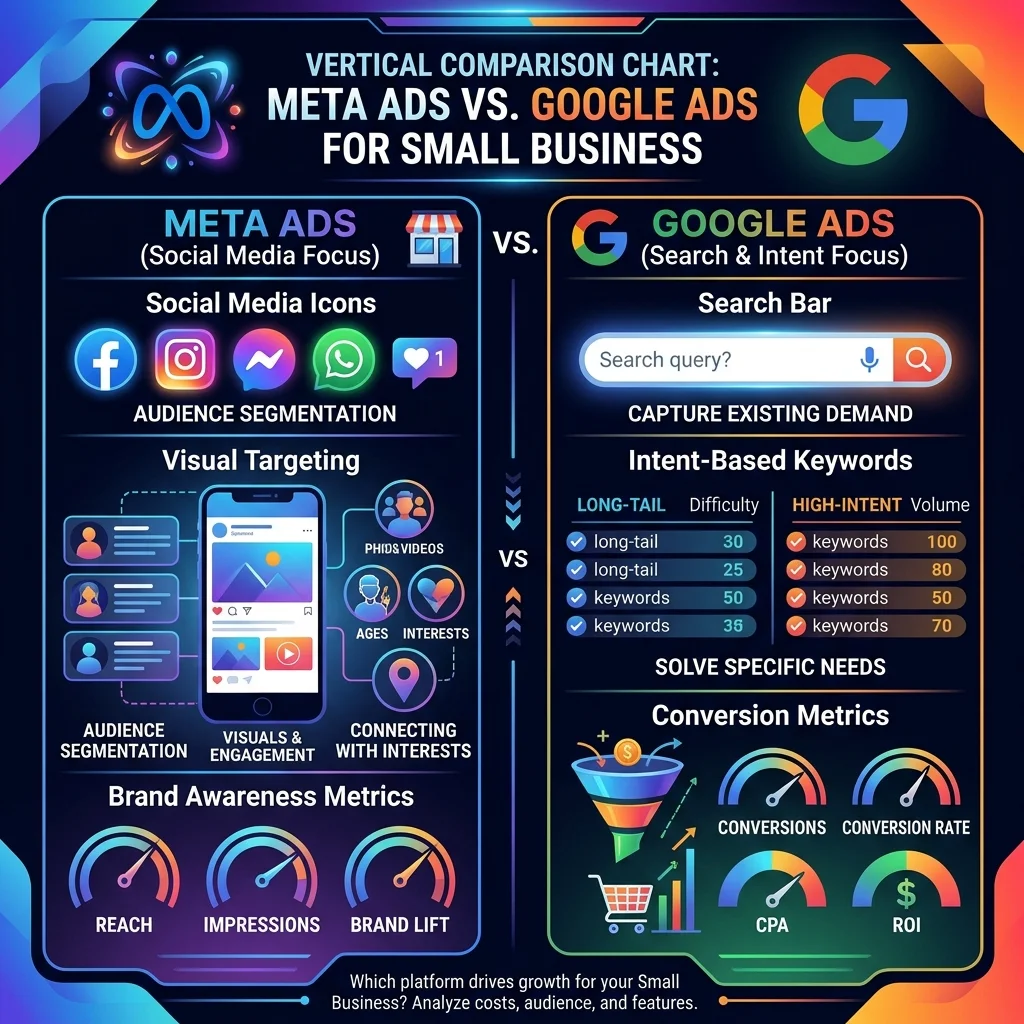
Google Ads shows your ads to people who are actively searching. Someone types “dentist in Jounieh” or “buy running shoes Beirut”, and your ad appears because their search matches your keywords. You’re capturing demand that already exists.
Meta Ads, across Facebook and Instagram, shows your ads to people based on who they are and what they’re interested in, while they scroll through their feed, Stories or Reels. They weren’t looking for you, but your ad catches their attention. You’re creating demand, or at least awareness and interest.
That single difference explains most of the Facebook ads vs Google ads decision. Search intent tends to convert faster; social reach tends to be broader and more visual.
Meta Ads vs Google Ads at a Glance
| Google Ads | Meta Ads | |
|---|---|---|
| How people find you | They search for something you offer | Your ad appears while they browse |
| Main strength | High intent, ready to act | Reach, visual storytelling, targeting by audience |
| Key formats | Search text ads, Maps, Shopping, YouTube, Display | Images, video, Reels, Stories, carousels, collections |
| Creative needs | Strong keywords, clear ad copy, good landing page | Eye-catching visuals and video, a compelling offer |
| Best for | Services people search for, urgent needs, high-value leads | Visual products, new offers, impulse purchases, local awareness |
When Google Ads Is the Better Starting Point?
Start with Google when the demand already exists and people go looking for it.
People search for what you sell
If customers type your product or service into Google, you want to be there when they do. Plumbers, clinics, law firms, accountants, driving schools, car rentals, real estate agents and B2B services often get their best early results from search, because the person clicking already has a need.
Urgent and local needs
When someone needs a locksmith, a repair or an appointment today, they search, often on their phone with “near me” or a city name. Google Ads, combined with an accurate Google Business Profile, puts you in front of them at exactly the right moment.
High-value leads
For services where one client is worth a lot, search ads can be very efficient even if clicks cost more, because the people clicking are closer to buying. Track leads carefully so you know what each new client really costs.
Search and Maps working together
For businesses with a physical location, Google’s reach extends beyond the search results page. Your Google Business Profile, reviews and location details appear in Maps results, and search campaigns can include location and call details so people can phone or get directions in one tap. A clinic, garage or restaurant that combines search ads with a well-maintained Google profile often captures more local demand than either could alone.
When Meta Ads Is the Better Starting Point?
Start with Meta when your product sells visually, or when people don’t yet know to search for it.
Your product sells on looks or experience
Fashion, beauty, food, home decor, events and hospitality all benefit from showing rather than telling. A well-made Reel or carousel can create desire in seconds in a way a text ad can’t.
Your audience lives on Instagram and Facebook
Meta’s platforms reach a large share of Lebanon’s population. Data compiled by NapoleonCat from Meta’s advertising tools shows around 4.9 million Facebook users and 3.3 million Instagram users in Lebanon in September 2026, with Instagram’s audience split almost evenly between women and men. These are audience estimates rather than unique individuals, but they show how widely Meta can reach Lebanese consumers.
You’re launching something new
If your product is new or your category isn’t widely searched yet, there may be little search demand to capture. Meta lets you introduce it to the right audience and build that demand.
Conversations close your sales
Many Lebanese businesses sell through Instagram DMs and WhatsApp. Meta’s ads can send people straight into a conversation, which suits businesses where questions, sizing or customisation come before the sale.
What Each Platform Needs to Work?
Both platforms fail for predictable reasons. Google Ads needs well-chosen keywords, negative keywords to block irrelevant searches, ad copy that matches what people searched for, a fast, relevant landing page and conversion tracking. Sending search traffic to a slow homepage is one of the most common ways to waste budget.
Meta Ads needs strong creative above all: vertical video and images that stop the scroll, a clear offer, and the Meta Pixel and Conversions API so the platform can learn who converts. Without fresh creative, Meta campaigns tire quickly; without tracking, they optimise blind.
Budgeting for Your First Campaign
For most small businesses, the smartest approach is to start with one platform, give it a fair test and expand once it works. Splitting a small budget across both platforms from day one often leaves each without enough data to learn. Decide how much you can spend over two to three months, set clear goals such as cost per lead or cost per sale, and review weekly.
Costs vary by industry, competition, season and audience, so treat your first month as a learning phase rather than judging results after a few days. In Lebanon, also make sure you have a payment card that works reliably for international USD billing, since both platforms charge in dollars. For a wider view of how paid ads fit with your other channels, see our guide to small business marketing strategy.
Which to Choose: Examples by Business Type
Here’s how the Meta ads vs Google ads decision often plays out for different businesses:
- A clinic or law firm: start with Google search, add Meta later for awareness and retargeting
- A fashion boutique: start with Meta on Instagram, add Google Shopping or search for branded searches
- A restaurant: Meta for discovery and offers, plus a strong Google Business Profile for searches
- An online store: often both, with Meta for discovery and Google for shoppers searching specific products
- A B2B service: Google search first, with LinkedIn or Meta retargeting as support
Common Mistakes With Paid Advertising in Lebanon
The same handful of errors drain budgets again and again in paid advertising in Lebanon. Businesses boost random posts from the Instagram app instead of running structured campaigns with clear objectives. They target “all of Lebanon” when they can only deliver to a few areas. They send Google traffic to a homepage instead of a page that matches the search. They run the same Meta creative for months until performance collapses. They don’t install tracking, so they can’t tell which ads produced leads. And they judge a campaign after three days, before the platform has had time to learn. Avoiding these mistakes often improves results more than increasing the budget.
Running Both Together
Once your first channel is working, the two platforms complement each other well. Meta builds awareness and interest; Google captures people when they later search for your brand or category. Retargeting connects them: people who visited your site from Google can see your Meta ads, and people who engaged with your Instagram content can be reached again on search and YouTube. Many established businesses end up using both, with budget shifting between them based on results and season.
A simple way to begin running both is to keep your first platform as the main engine and give the second a small, focused role. For example, a clinic running Google search can add a modest Meta retargeting campaign aimed at people who visited its treatment pages but didn’t book. A boutique running Instagram ads can add Google search ads for its brand name, so it captures people who saw an ad and later searched for the shop. Each step adds reach without diluting the channel that already works, and the data from one platform helps refine the other.
The same principles apply across the region, though setup and budgets differ by market. Our guide to Google Ads setup for Qatar covers that market specifically.
Measuring Fairly
Google and Meta measure results differently, and each platform tends to give itself credit generously. Use one consistent source of truth, such as Google Analytics with tracked links, or simply your own record of where each lead came from. Compare platforms on cost per lead, cost per sale and lead quality, not just clicks or reach. Remember that Meta often influences customers who later convert through search, so look at the combined picture before cutting a channel.
Start Where Your Customers Are
The Meta ads vs Google ads choice comes down to one question: are your customers already searching for what you offer? If yes, start with Google and capture that demand. If your product sells visually or people don’t yet know to look for it, start with Meta and create demand. Test one platform properly, measure what really matters, then add the other once the first is working.
Plan your first campaign with us.
mediaSine helps Lebanese businesses choose the right starting platform, set up tracking and run campaigns that are measured on real leads and sales.
Frequently Asked Questions
Usually, yes. B2B buyers often search for specific services or solutions, so Google search tends to be the stronger starting point. Meta and LinkedIn can support awareness and retargeting.
Meta often has lower costs per click or impression, while Google clicks can cost more but come from people with stronger intent. Compare cost per lead or sale, not cost per click.
Give a campaign at least a few weeks, and ideally two to three months, to gather enough data and optimise. Early results often improve as the platform learns.
On Meta, yes: ads can send people to your Instagram profile, a form or WhatsApp. On Google, a website or landing page is strongly recommended for search campaigns.
