
Ask a Doha marketing team to describe its customer and you’ll often hear “everyone in Qatar.” It’s an understandable answer in a country where residents come from more than a hundred nationalities, but it’s rarely a useful one. A campaign written for everyone tends to land with no one in particular. Defining your target audience in Qatar means breaking a diverse market into groups you can actually speak to, through the right language, the right channels and the right moments.
This guide explains why segmentation matters so much in Qatar, how to segment by language and community without falling into stereotypes, how life stage and spending power cut across nationality, and how to build segments from your own data. If you’d like support, our page on digital marketing in Qatar explains how MediaSine works with Qatari brands.
Why Your Target Audience in Qatar Needs Segmenting?
Qatar’s population is small but unusually diverse. DataReportal’s Digital 2026 report puts the total at around 3.13 million people at the end of 2025, with a strong male skew of roughly 71 percent, which largely reflects the size of the country’s expatriate workforce. Qatari nationals are a minority of residents, and official breakdowns by nationality aren’t routinely published, so treat any precise figures you come across with caution.
For marketers, the implication is clear. A message that resonates with Qatari families may mean little to a young professional from Manila, and a campaign built for Western expats in The Pearl may miss Arab families in Al Wakrah entirely. Good Qatar consumer segments help you decide who to prioritise, what to say and where to say it, instead of averaging your message until it fits nobody.
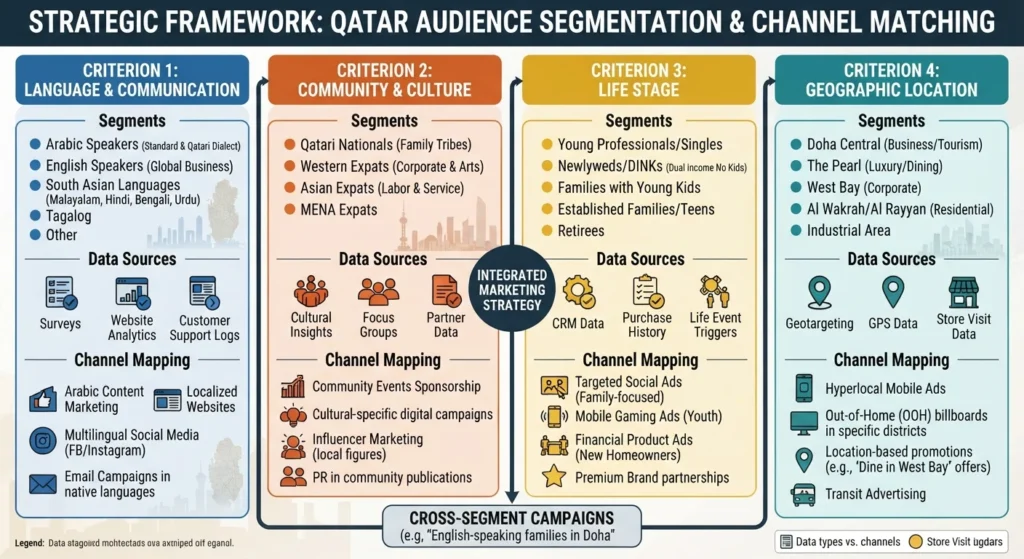
Start With Language
Language is often the most practical first cut. It’s visible in your data, it can be targeted in ads, and it shapes everything from captions to customer service.
Arabic reaches Qatari nationals and Arab expatriates, though tone and dialect matter: Gulf Arabic feels natural to Qatari audiences, while a lighter, widely understood Arabic often works better across Arab communities. English is the shared language for most of the rest of the market and a common working language for Arabic speakers too. Some brands go further and reach specific communities in their own languages, such as Hindi, Malayalam, Urdu, Bengali, Nepali or Tagalog, usually through targeted campaigns rather than the main feed. Our guide to Arabic vs English content covers how to structure bilingual posting.
Language segmentation is also the easiest place to start testing. Run the same campaign in Arabic and English to similar audiences, compare the results, and you’ll quickly learn which parts of your target audience in Qatar respond to which language, and for which products.
Key Communities and What to Consider
The groups below are broad starting points, not boxes to put people in. Every community includes a wide range of incomes, ages, professions and tastes. Use these as prompts for research, then let your own customer data refine them.
Qatari nationals
Qatari audiences are often reached most naturally in Arabic, with content that reflects local culture, family life and national occasions such as Ramadan, Eid and Qatar National Day. Research commissioned by Snap suggests Snapchat over-indexes on young Qatari users, which makes it an important channel for brands targeting this group alongside Instagram.
Arab expatriates
Qatar is home to large communities from across the Arab world, including Egypt, the Levant, Sudan and North Africa. Arabic content often works well, but dialect and cultural references vary, so a message that feels distinctly Gulf may not land the same way. Many Arab expatriate families share similar seasonal moments, such as Ramadan, Eid and back-to-school.
South Asian communities
Communities from India, Pakistan, Bangladesh, Nepal and Sri Lanka make up a large part of Qatar’s population and span every income level and profession. English reaches many, while content in community languages can build stronger connection for specific campaigns. Festivals such as Diwali, Onam and Eid are important moments for many households.
Southeast Asian communities
The Filipino community is one of Qatar’s most visible, alongside communities from Indonesia and other Southeast Asian countries. English is widely used, and Tagalog can add warmth in community-focused campaigns. Christmas is a major moment for many Filipino residents, and remittance, travel and family-focused messaging often matter.
Western and other international residents
Residents from Europe, North America, Africa and elsewhere generally respond to English content. Many are in professional roles, but this group, like every other, varies widely. Seasonal moments include Christmas, summer travel and school calendars tied to international schools.
Visitors
Qatar attracts business travellers, event visitors and tourists, particularly around major sporting and cultural events. For hospitality, retail and experiences, visitors can be a distinct segment with short decision windows and different information needs.
Beyond Nationality: Life Stage, Income and Location
Nationality is only one lens, and often not the most useful one. Strong expat marketing in Qatar and local marketing alike pay attention to the factors that cut across communities.
Life stage
A young single professional, a family with school-age children and a retired parent visiting relatives make very different decisions, whatever their nationality. Families often care about value, convenience and child-friendly options; young professionals may respond to social, fitness and dining experiences. Life stage frequently predicts behaviour better than passport.
Spending power
Income varies enormously within every community in Qatar. Avoid assuming spending power from nationality. Instead, let your product, price point and customer data define the income segments you serve, and target accordingly.
Neighbourhood
Where people live and work shapes what they can reach easily. A café in Msheireb, a gym in Lusail and a supermarket in Al Rayyan serve different catchments. Location targeting in ads, along with an accurate Google Business Profile, helps you reach the people who can actually visit.
Matching Channels to Segments
Different segments favour different platforms. Instagram works across most groups as a brand storefront. Snapchat is particularly strong with young Qatari audiences. TikTok has the broadest reported reach. Facebook remains relevant for some communities, and LinkedIn matters for professional and B2B audiences. WhatsApp groups and community pages can be powerful for reaching specific communities. Our guide to platform choices in Qatar compares the main options with audience data.
Paid social makes segmentation practical. Language, location, age and interest targeting let you show each segment a version of your message built for it, rather than one compromise version for everyone. Platform targeting options change over time, so check what’s currently available before planning a campaign.
Planning Around Every Community’s Calendar
Qatar’s marketing calendar is richer than a single set of national holidays. Ramadan, Eid and Qatar National Day matter across much of the population. Christmas is significant for many Filipino, Western and other Christian residents. Diwali and Onam matter to many South Asian households. Summer travel and the back-to-school period affect families across communities.
Mapping these moments against your segments helps you plan relevant campaigns throughout the year, rather than concentrating all your effort on two or three dates. If you run offers or giveaways around these occasions, remember to plan for the necessary promotion permits.
Building Segments From Your Own Data
General descriptions only go so far. The most useful segments come from your own customers. Start with what you already have:
- Language customers use in messages, comments and reviews
- Location data from deliveries, bookings or Google insights
- Purchase patterns by product, price point and time of year
- Audience insights from Instagram, Snapchat and TikTok
- Direct feedback from simple questions at checkout or booking
Look for two or three groups that together account for most of your revenue or growth potential. Those are your priority segments. Write a short profile for each, covering who they are, what they need, which language and channels suit them and which moments matter, and build your plan around those profiles.
Revisit these profiles every six months or so. Qatar’s population shifts with new projects, events and economic cycles, and your target audience in Qatar may look different a year from now. Brands that update their segments regularly spot new opportunities, such as a growing community near a new branch or a rising interest in a product line, long before competitors do.
An example: a gym in Doha
Picture a gym in Lusail. Its data shows three main groups: young professionals of many nationalities who train after work and respond to English content on Instagram; Arabic-speaking families interested in women-only and children’s classes, best reached in Arabic on Instagram and Snapchat; and corporate clients booking group memberships through LinkedIn and direct outreach. Each group gets its own message, language and channel, and the gym’s calendar includes Ramadan timetables, a National Day challenge and New Year fitness campaigns. This is an illustrative scenario, not a client example.
Segment Responsibly
Segmentation is about relevance, not judgement. Avoid stereotypes in imagery, language and offers, and don’t treat any community as a single type of customer. Represent people respectfully, involve people from the communities you’re targeting when creating content, and make sure segmented pricing or offers stay fair and legal. Done well, segmentation makes every customer feel addressed; done badly, it makes people feel reduced to a label.
Frequently Asked Questions
There isn’t one. It depends on your product, price point and location. Most consumer brands serve several segments, typically defined by language, life stage and spending power rather than nationality alone.
Most brands benefit from both, but not necessarily in every post. Targeted ads and separate versions let each segment see one clean message in the language that suits it.
For brands that serve these communities significantly, targeted content in community languages can build strong connection. Start with specific campaigns and measure the response before scaling.
Total population figures are published regularly, but detailed breakdowns by nationality are not routinely available. Use official and reputable sources, and rely on your own customer data for decisions.
Speak to Segments, Not “Everyone”
Defining your target audience in Qatar turns a diverse, complicated market into a set of groups you can genuinely reach. Start with language, understand the communities you serve without stereotyping them, layer in life stage, income and location, match channels to segments and plan around every community’s calendar. Build it all from your own data, and your marketing will speak clearly to the people most likely to buy.
Build your Qatar audience plan.
mediaSine can help you define your priority segments in Qatar and plan the languages, channels and campaigns to reach them.
