
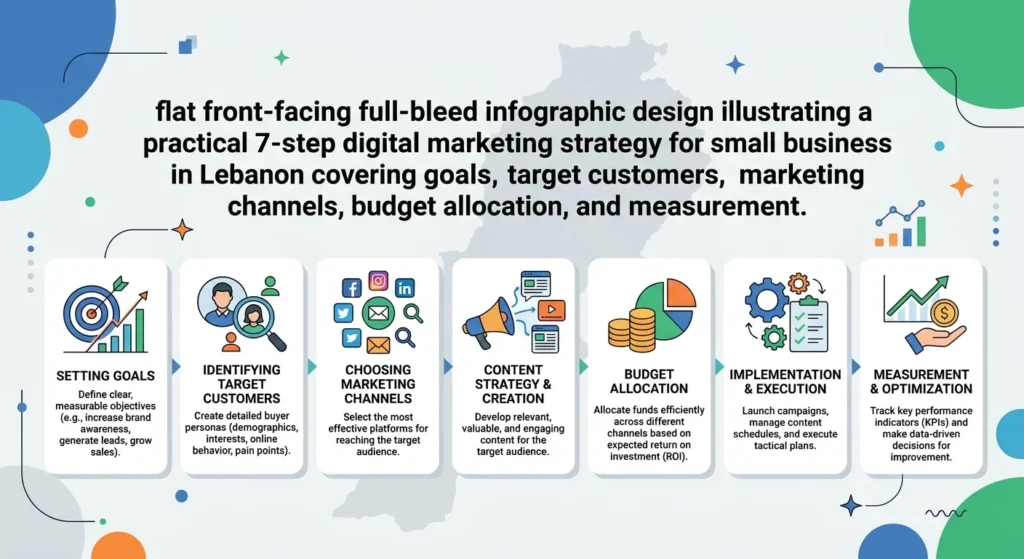
Most small businesses in Lebanon don’t lack marketing activity. They post on Instagram, reply on WhatsApp, maybe boost a post now and then. What they often lack is a plan that ties it together: a clear goal, a defined customer, a few channels chosen on purpose and a way to tell whether any of it is working. A digital marketing strategy for small business doesn’t need to be a 40-page document. It needs to fit on a page and guide what you do every week.
This guide walks you through seven practical steps to build that plan, with examples drawn from how Lebanese businesses actually sell: through Instagram, WhatsApp, Google Maps and word of mouth. If you’d rather build it with a team, mediaSine’s digital marketing services cover strategy, execution and reporting.
What a Digital Marketing Strategy for Small Business Really Is?
A strategy isn’t a list of channels. “We’ll be on Instagram, TikTok and Google” is a set of activities, not a plan. A real strategy answers four questions: what do we want to achieve, who are we trying to reach, where will we reach them and how will we know it’s working?
For a small business, the best strategies are simple and focused. They choose a few things to do well instead of many things to do badly. They reflect the realities of the market: in Lebanon, that means customers who move between Arabic, English and French, a strong reliance on WhatsApp and Instagram for everyday buying, pricing in US dollars and, for many businesses, an audience that includes Lebanese living abroad. A good digital marketing plan in Lebanon builds those realities in from the start.
Step 1: Set One Clear Business Goal
Start with the business, not the marketing. What needs to change over the next six to twelve months? More weekday bookings, more online orders, more enquiries for a service, more visits to a new branch? Pick one main goal. You can have secondary goals, but one should lead.
Turn the goal into something you can measure
“Grow the business” can’t guide decisions. “Increase WhatsApp orders from 20 to 40 a week by June” can. A measurable target tells you which channels matter, how much effort to put in and whether you’re on track. If you don’t know your current numbers, your first task is simply to start counting: orders, enquiries, bookings and where each one came from.
Step 2: Know Exactly Who You’re Talking To
Small businesses often try to speak to everyone, which usually means speaking clearly to no one. Describe your best customers as specifically as you can: age range, neighbourhood or region, what they buy, why they choose you and how they first found you.
Local, national or diaspora?
A café in Achrafieh, an online shop delivering across Lebanon and a business selling to Lebanese abroad need very different plans. Be clear about geography from the beginning, because it shapes your channels, your ad targeting, your delivery promises and even your posting times.
Which language do they use?
Language is a strategic choice in Lebanon. Look at the language your customers use in comments, messages and reviews, and plan content around it. Our guide to choosing languages for your content explains how to balance Arabic, English and French.
Step 3: Fix Your Foundations First
Before spending on content or ads, make sure the places customers check are ready. Foundations are cheap to fix and expensive to ignore, because every other channel sends people to them.
Google Business Profile
When people search for your business or for something “near me”, your Google Business Profile is often the first thing they see. Claim it, keep your hours, phone number and location accurate, add good photos and reply to reviews. For local businesses, this alone can bring a steady flow of calls and visits.
A website or landing page
Not every small business needs a large website, but most need somewhere that explains what they do, shows prices or products and makes it easy to get in touch. A simple, fast, mobile-friendly site builds trust and supports search visibility. Our guide to website costs in Lebanon explains what different options involve.
WhatsApp Business
For many Lebanese businesses, WhatsApp is where sales actually close. Set up WhatsApp Business with a catalogue, quick replies for common questions and clear opening hours. Then link to it from Instagram, Google and your website, so interest turns into conversation in one tap.
Step 4: Choose Two or Three Channels
Small budgets go further when they’re concentrated. Choose the two or three channels closest to your customers and your goal, and do them properly before adding more.
Social media
For most consumer brands in Lebanon, Instagram is the main storefront, with TikTok and Facebook playing supporting roles depending on the audience. Focus on content that shows your product, your people and your customers, and make buying easy. If you want support, see how mediaSine approaches social media management.
Search and SEO
If people search for what you offer, such as a service, a product type or a business category in your area, search visibility can bring high-intent customers. SEO takes time to build, but the traffic it brings is durable. Combine it with a strong Google Business Profile for local searches.
Paid advertising
Paid ads can speed things up, whether that’s reaching new people on Instagram or capturing searches on Google. The right starting point depends on whether your customers are actively searching or need to discover you. Our comparison of Meta ads vs Google ads helps you decide where to begin.
Direct channels
WhatsApp broadcast lists, customer groups and email newsletters let you reach existing customers without paying for every message. Repeat customers are usually your most profitable ones, so don’t neglect the people who already know you.
Step 5: Plan Content You Can Actually Sustain
Consistency beats intensity. A business that posts three good pieces of content a week for a year will usually outperform one that posts daily for a month and then disappears. Decide on a realistic rhythm, choose a few recurring themes, and plan a month at a time. Batch your photography and video so you’re not scrambling every day. If you run a restaurant or café, our restaurant content calendar template shows what this looks like in practice.
Step 6: Set a Realistic Budget
There’s no universal right number, but there is a sensible structure. Spend first on foundations, then on content and community, and only then on paid promotion. Budget in US dollars, include your own time, and decide in advance what you’ll test and for how long. Most small businesses get better results from a modest, consistent budget over six months than a large burst for one month.
If you’re considering outside help, compare scope carefully. Our guide to social media management costs explains what typically sits inside a retainer.
Step 7: Measure What Matters and Adjust
Track a handful of numbers connected to your goal, review them monthly and make one or two changes at a time. Useful measures for SME marketing in Lebanon include:
- Enquiries and orders, including WhatsApp messages and calls
- Where customers came from, by asking new customers directly
- Google Business Profile actions: calls, directions and website clicks
- Saves, shares and messages on social posts
- Cost per enquiry or order from any paid campaigns
Likes and follower counts can be encouraging, but they shouldn’t drive decisions. If a channel isn’t contributing to your goal after a fair test, cut it and put the effort elsewhere. A simple spreadsheet updated once a month is usually enough to spot what’s working.
A One-Page Plan: An Example
Here’s how the steps come together for a hypothetical bakery in Beirut that wants more pre-orders for cakes and celebration boxes.
The goal is to double weekly cake pre-orders within six months. The customers are mainly women aged 25 to 45 in Beirut and nearby areas, buying for birthdays and family occasions, who message in a mix of English and Arabic. The foundations are an updated Google Business Profile with menu photos, a simple website with a pre-order form and WhatsApp Business with a cake catalogue. The channels are Instagram as the main storefront, a small paid budget promoting occasion cakes to the local area, and a WhatsApp broadcast list for regulars. Content runs three posts a week plus daily Stories, built around new designs, behind-the-scenes decorating and happy customers. Each month, the bakery reviews pre-orders, where they came from and which posts led to messages.
That’s a complete digital marketing strategy for small business owners can follow, and it fits on one page. This is an illustrative scenario, not a client example.
When to Get Outside Help?
Many small businesses build and run their own plan, especially at the start. Getting help makes sense when you need skills you don’t have, such as photography, video, ads or SEO, when the plan is working but you lack the time to keep it going, or when results have stalled and you need a fresh perspective. If you’re weighing that step, our guide to choosing an agency gives you the questions to ask.
Frequently Asked Questions
Review your numbers monthly and your overall strategy every six months, or whenever something significant changes, such as a new product, branch or market. Small adjustments monthly prevent big surprises later.
Not always at the very start, but a simple website builds trust, supports search visibility and gives you a channel you control. As the business grows, it becomes increasingly valuable.
Start where your customers already are and where your goal is easiest to achieve. For many consumer businesses that’s Instagram plus Google Business Profile; for service businesses, search visibility may matter more.
Paid ads can produce enquiries within days or weeks. Social media and SEO usually take a few months to build momentum. Give each channel a fair test before judging it.
Build a Plan You Can Follow
The best digital marketing strategy for small business owners in Lebanon is the one they’ll actually use. Set one clear goal, know your customer, fix your foundations, focus on two or three channels, plan content you can sustain, budget sensibly and measure what matters. Revisit it regularly, and your marketing will stop being a collection of random activities and start working as a system that grows the business.
Get a strategy session.
Bring your goal and your current numbers, and mediaSine will help you shape a practical digital marketing plan for your business
