
“Hi, kifak, ça va?” It’s the greeting everyone jokes about, and it’s also a fair summary of how Lebanon talks. Customers here move between Arabic, English and French in a single sentence, so brands face a question their peers in most countries never do: which language should we post in? Getting multilingual social media in Lebanon right isn’t about translating everything three times. It’s about knowing which language does which job for your audience.
This guide walks through what each language signals, how to match languages to your customers, five practical ways to structure trilingual posting, and how to write Arabic that feels native rather than translated. If you’d like a team to plan and write this for you, our page on social media content in Lebanon explains how mediaSine works.
Why Language Is a Strategic Choice in Lebanon?
In a monolingual market, language is a given. In Lebanon, it’s a positioning decision. The language you choose tells people who you think your customer is, what kind of brand you are and how formal or familiar you want to sound. Two cafés with identical menus can feel completely different depending on whether their captions are in Lebanese Arabic, English or French.
What each language tends to signal?
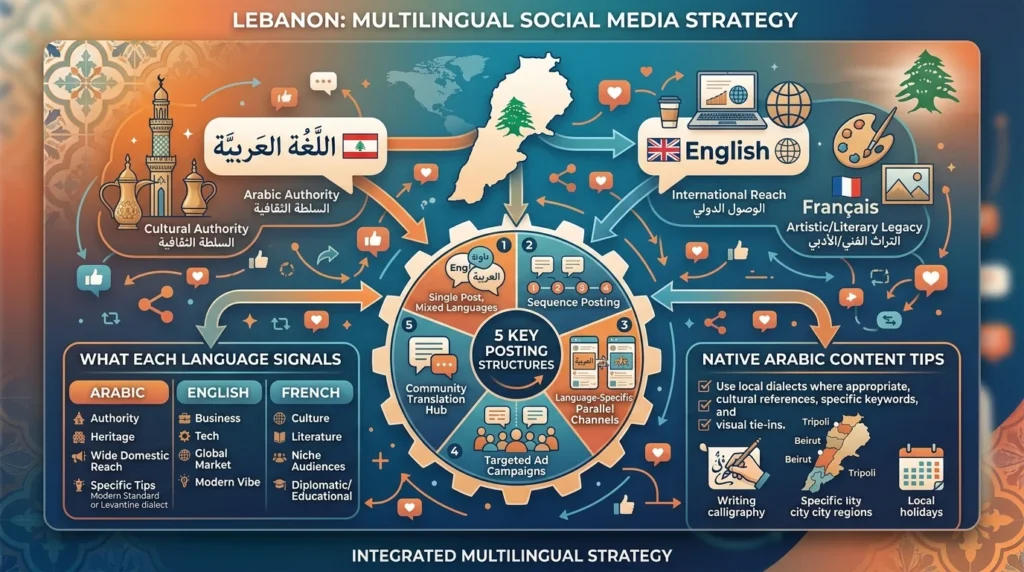
Arabic brings warmth, familiarity and reach. Written in the Lebanese dialect, it sounds like a friend talking. Written in Modern Standard Arabic, it sounds official, which suits announcements, government-facing brands and some institutional content but can feel stiff on Instagram. Arabic also opens your content to audiences across the region, and good Arabic social media content is often the clearest way to speak to the widest Lebanese audience.
English is the default for many lifestyle, tech, hospitality and fashion brands, especially those targeting younger, urban audiences or customers abroad. It feels international and contemporary, and it’s the language most global trends and formats arrive in.
French carries associations with heritage, elegance and certain education and professional circles. It remains strong for some luxury, beauty, fashion, food and cultural brands, and for audiences who grew up in francophone schools. For the right brand it adds character; for the wrong one it narrows the audience.
Code-switching and Arabizi
Lebanese people often mix languages naturally, and many write Arabic in Latin letters with numbers standing in for certain sounds, known as Arabizi (“3a2belak,” “yalla,” “kifak”). Brands can borrow this playful, informal register in captions, Stories and comments, where it sounds authentic and local. Used in the wrong place, a formal announcement, a corporate brand, a regional audience, it can look careless. Treat it as seasoning, not the main dish.
Matching Language to Your Audience
The right mix starts with who you’re talking to, not with what feels most stylish. A few patterns help as a starting point, though your own data should always have the final word.
A brand aiming at young, urban customers in Beirut often leads with English and adds Lebanese Arabic for humour and warmth. A brand with a wider national audience, across different regions and age groups, usually benefits from putting Arabic at the centre. Heritage, luxury and some beauty brands may keep French as an accent or a lead language for specific audiences. And brands selling to the Lebanese diaspora or to Gulf customers need to think about who will read the content outside Lebanon, which often means English for the diaspora and Arabic written for Gulf readers when targeting the region.
It also helps to remember that your audience isn’t fixed. A brand that started with English-speaking customers in Beirut may find, as it grows into other regions or opens a second branch, that Arabic needs a bigger role. Good multilingual social media in Lebanon evolves with the customer base rather than locking in the choices made at launch.
Look at your own data first
Before you redesign your language strategy, look at what your customers already do. Which language do they comment in? Which language appears in DMs and WhatsApp enquiries? Which past posts in which language earned the most saves, shares and messages? Your existing followers have been telling you their preferences for months; the answer is often hiding in your inbox.
Five Ways to Structure Multilingual Social Media in Lebanon
There’s no single correct format. These five approaches cover most brands, and many combine two of them.
1. One lead language with accents
Choose one language for most captions and add phrases or words from another for personality. An English-led brand might sign off in Lebanese Arabic; an Arabic-led brand might use English for product names. This is the simplest approach and works for most small businesses.
2. Bilingual captions
Write the caption in two languages, one after the other. It doubles your reach within a single post, but it also doubles the length, so keep each version short. Put the language most of your audience reads first, because many people won’t scroll past the first lines.
3. Separate posts per language
Some brands alternate: an Arabic post one day, an English post the next. This keeps captions clean and lets each language have its own tone and hooks. It works best for accounts that post often enough that neither audience feels neglected.
4. Language by format
Use different languages for different formats. Reels might feature people speaking in Lebanese Arabic, with English on-screen text; carousels might be written in English; Stories might mix freely. Matching language to format often feels more natural than forcing one rule everywhere.
5. Language by campaign or audience
Run specific campaigns in the language of their audience: an Arabic campaign for Ramadan, an English campaign aimed at summer visitors from abroad, a French-led campaign for a heritage collection. Paid ads make this easier, because you can target audiences by language and location rather than asking every follower to read every version.
Writing Arabic Content That Feels Native
The fastest way to lose trust in Arabic is to sound translated. Customers spot machine translations and awkward phrasing immediately, and it undermines the warmth that made Arabic worth using in the first place.
Dialect or Modern Standard Arabic?
For most consumer brands, Lebanese dialect suits social media better: it’s how people actually speak and message each other. Modern Standard Arabic has its place for formal statements, institutional brands or content aimed at audiences across the Arab world. Some brands use both: dialect for everyday posts and Standard Arabic for announcements. What matters is choosing deliberately and staying consistent.
Design and right-to-left layouts
Arabic reads right to left, which affects carousel order, text placement, video subtitles and how designs flow. Templates built for English often look wrong when Arabic text is dropped into them. Plan Arabic layouts from the start, choose Arabic typefaces that match your brand’s personality, and check that line breaks and punctuation render correctly before publishing.
Write, don’t translate
The strongest trilingual content in Lebanon is written separately for each language, not translated line by line. A joke that works in English may fall flat in Arabic; a French phrase may carry associations the English version doesn’t. Brief the idea once, then let each language’s writer adapt the hook, tone and call to action so it lands naturally.
Is French Still Worth It?
For many brands, French works best as a deliberate accent rather than a full third channel. It can add elegance to a fashion or beauty brand, connect with long-standing customers and give a heritage brand a distinct voice. But writing every post in three languages is time-consuming, and if French readers are a small part of your audience, that effort may be better spent producing stronger content in one or two languages. If you keep French, give it a clear role: specific campaigns, certain product lines or a particular audience.
Building a Workflow That Doesn’t Slow You Down
Multilingual posting fails most often on logistics, not ideas. Captions sit waiting for a translation, the Arabic version gets rushed, or nobody checks the French. A few habits prevent this.
The most common failure in multilingual social media in Lebanon is a brand that starts with three languages and quietly drops to one because nobody had time to write the other two. It’s better to commit to two languages you can sustain than to promise three and deliver them inconsistently.
Decide who writes each language and who approves it. Keep a short brand glossary with how you spell your brand name, product names and recurring phrases in each language, including any Arabizi you use. Write all language versions at the planning stage, not on the day of posting. And build Arabic and English layouts into your design templates so no one improvises at the last minute. mediaSine’s content creation services build this kind of workflow into monthly planning.
Measuring What Works
Treat your language strategy as something to test, not a rule set in stone. Over two or three months, track a few simple comparisons:
- Saves and shares on posts in each language
- Comments and DMs, and the language they’re written in
- Reach from non-followers by language and format
- Enquiries or orders following posts in each language
Look for patterns rather than single results. If Arabic Reels consistently reach new people while English carousels drive saves, that’s a structure worth keeping. If a third language rarely moves any number, it may be time to simplify. Teams in other markets face similar questions, and it’s useful to see how brands in Qatar balance Arabic and English, where the audience mix is very different.
Frequently Asked Questions
Not necessarily. Most brands do best with one lead language and a second as support, using the third only for specific audiences or campaigns. Posting everything in three languages is expensive and often waters down each version.
Usually not. Separate accounts split your followers and double the work. They make sense only for large brands with distinct audiences, for example a regional Arabic account alongside a local one.
For casual, youth-focused or playful brands, Arabizi can feel authentic in captions, Stories and replies. For corporate, luxury or regional audiences, stick to Arabic script or English.
It depends on your audience, so test it. Run the same ad in two languages to similar audiences and compare results. Many brands find that the winning language differs by product and audience segment.
Choose Languages on Purpose
Effective multilingual social media in Lebanon comes from giving each language a job. Arabic for warmth and reach, English for a contemporary, international voice, French for heritage and elegance, and Arabizi as a playful accent where it fits. Start with what your customers already use, pick a structure you can sustain, write each language natively and let the results guide your mix.
Plan your content languages with us.
mediaSine writes social media content in Arabic, English and French for Lebanese brands, and can help you decide which mix suits your audience.
