
Walk through any mall in Doha and you’ll hear Arabic, English, Hindi, Tagalog, Malayalam and a dozen other languages within a few minutes. Brands on social media face the same mix, and it raises a practical question every marketing team in Qatar has to answer: should we post in Arabic, English or both? Getting Arabic social media content in Qatar right matters for reach, for trust and, in some cases, for compliance. But it doesn’t mean every post needs two languages.
This guide explains why language works differently in Qatar, what the country’s Arabic language law means for brands, how to match language to the audience you want, and four practical ways to structure bilingual posting. If you’d prefer a team to plan and write it, our page on bilingual social media management explains how mediaSine works with Qatari brands.
Why Language Works Differently in Qatar?
Arabic is Qatar’s official language and a central part of national identity. At the same time, Qatari nationals are a minority of the country’s residents, and the expatriate population comes from across the Arab world, South and Southeast Asia, Africa, Europe and beyond. English has become the shared language of much of daily business and retail. The result is a market where both Arabic and English are essential, but for different people and different purposes.
Arabic is more than one register
“Arabic” on social media can mean several things. Modern Standard Arabic is the formal written language used in official communication, news and education. Gulf Arabic, including the Qatari dialect, is how many Qatari and Gulf audiences actually speak and message each other. And Qatar’s large Arab expatriate communities bring their own dialects, Egyptian, Levantine, Sudanese and others. A caption that feels natural to an Egyptian reader may feel slightly foreign to a Qatari one, and a formal caption in Modern Standard Arabic can feel distant on a casual Instagram Story.
English as the shared language
For many expatriate audiences, English is the most practical way to reach people who don’t share a first language. It’s also common among younger Qataris and among professionals across industries. That makes English the default for many retail, hospitality and lifestyle brands, especially in Doha’s international neighbourhoods, while Arabic remains essential for reaching Qatari and Arab audiences and for brands whose identity is rooted in local culture.
What Qatar’s Arabic Language Law Means for Brands?
Language in Qatar isn’t purely a marketing choice. The Amir issued Law No. 7 of 2019 on the protection of the Arabic language, which commits governmental and non-governmental organisations to supporting Arabic. Among other things, the law requires government entities to use Arabic in their communications and publications, requires trademarks and commercial names to be written in Arabic, and states that where another language is used alongside it, Arabic should be given the most prominent place.
For most private brands, the practical takeaway is straightforward: have an Arabic version of your brand name, use it consistently, and don’t treat Arabic as an afterthought in visible branding and advertising. For government, semi-government and public-sector clients, Arabic-first communication is generally expected. If you’re unsure how the law applies to a particular campaign, product label or ad format, check with a legal adviser before publishing.
Matching Language to Your Audience in Qatar
The right mix depends on who you need to reach. These broad groups are a useful starting point, though your own audience data should always guide the final decision.
Qatari nationals and Gulf audiences
If your customers are Qatari families, young Qataris or Gulf visitors, Arabic should lead, ideally written in a tone that feels natural to Gulf readers. Arabic content also matters on the platforms where these audiences are most active. Snapchat, for example, tends to over-index on young Qatari users, as we explain in our guide to platform choices in Qatar.
Arab expatriates
Arab expatriates often respond well to Arabic content, but tone matters. Highly local Gulf slang may not land with everyone, while Modern Standard Arabic can feel formal. Many brands use a light, widely understood Arabic that works across dialects, or simply pair Arabic with English.
International and Asian expatriate communities
For broad expatriate audiences, English is usually the most effective shared language. Some brands serving specific communities go further and add content in other languages, but that works best when it’s targeted, through ads or community-specific campaigns, rather than added to every post.
Government, corporate and B2B audiences
Government and semi-government audiences generally expect Arabic-first communication, often in Modern Standard Arabic. Corporate and B2B audiences in Qatar frequently work in English, especially on LinkedIn, but Arabic versions of key announcements show respect for the market and help with public-sector buyers.
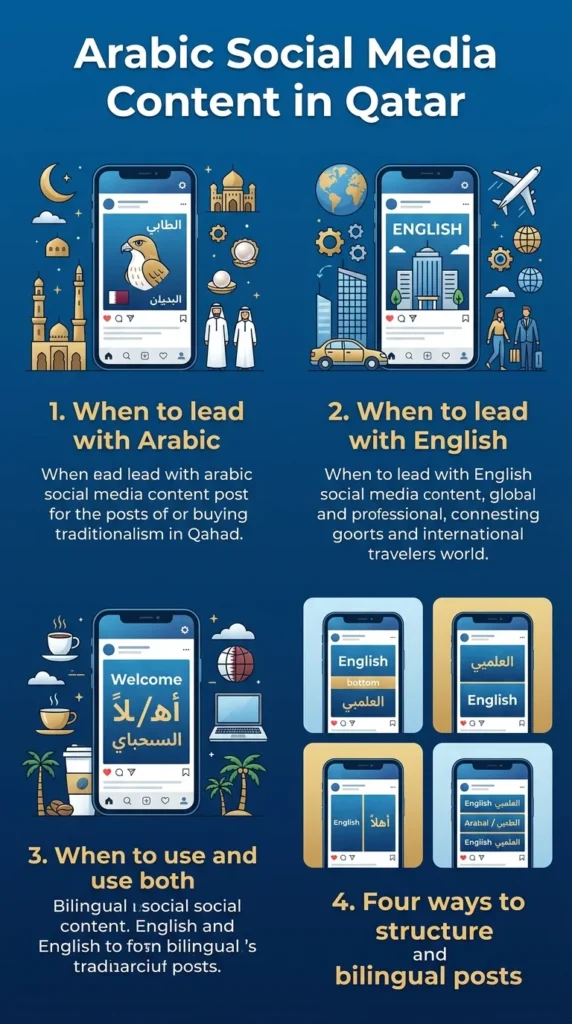
Four Ways to Structure Arabic Social Media Content in Qatar
Once you know your audience, choose a structure you can sustain. Most brands use one of these four, or combine two.
1. Arabic first, English second
Lead with Arabic in visuals and captions, with an English version underneath. This suits brands targeting Qatari and Arab audiences, government-facing brands and those whose identity is rooted in local culture. It also aligns naturally with the law’s emphasis on Arabic prominence in visible branding.
2. English first, Arabic second
Lead with English and include an Arabic version below. This suits retail, hospitality and lifestyle brands with large expatriate audiences that still want to reach Arabic speakers. Make sure the Arabic is complete and well written, not a shortened afterthought.
3. Separate posts or versions per language
Create an Arabic version and an English version of key posts, each with its own caption, on-screen text and sometimes different visuals. This takes more work, but it lets each version speak naturally to its audience. It’s common for campaign launches, seasonal content and paid ads.
4. Language by campaign or ad set
Use paid targeting to show Arabic ads to Arabic-speaking audiences and English ads to others, while keeping the organic feed bilingual or English-led. This is often the most efficient approach for bilingual content in Doha, because each audience sees one clean message instead of two languages squeezed into one post.
To see how this plays out, picture a Doha café with a mixed clientele. Its feed might run English-first captions with full Arabic versions underneath, while its Ramadan campaign is written Arabic-first and its weekday lunch ads run as separate Arabic and English versions targeted to different audiences. Three structures, one brand, each chosen for the job in front of it. This is an illustrative scenario, not a client example.
Getting Bilingual Content Right
Bilingual posting fails most often in execution: an Arabic caption that sounds translated, a design built for English with Arabic text squeezed in, or a seasonal message that misses the tone. A few habits make a big difference.
Write for Gulf readers, don’t translate
Brief the idea once, then have a native Arabic writer adapt the message for Gulf audiences rather than translating the English line by line. Hooks, humour and calls to action often need to change. Consider who will read the Arabic: a Qatari audience, a broader Arab audience or both. Literal translations are easy to spot and quietly undermine trust in the brand.
Design for both directions
Arabic reads right to left, English left to right. Carousels, on-screen text, subtitles and layouts need to work in both directions. Build bilingual templates from the start, choose Arabic typefaces that match your brand’s personality and check line breaks, punctuation and numbers in both languages before publishing.
Get seasonal tone right
Ramadan, Eid and Qatar National Day on 18 December carry cultural weight, and Arabic content often matters most at these moments. Greetings, imagery and tone should feel respectful and authentic. Plan these posts in Arabic first, then adapt them into English, rather than the other way round.
Language Beyond Social Media
The same audience questions apply to your website and search strategy. People in Qatar search in both Arabic and English, and the results can look very different depending on the language. If you’re planning bilingual social media, it makes sense to consider your search language at the same time. Our guide to Arabic vs English SEO in Qatar covers that decision. Brands working across markets may also find it useful to compare language choices for Lebanese brands, where the mix of languages and audiences is very different.
Measuring What Works
Treat your language choice as something to test. Over two or three months, compare saves, shares, comments and enquiries on Arabic, English and bilingual posts. Look at the language people use in comments and messages. In paid campaigns, run Arabic and English versions of the same ad to similar audiences and compare cost per result. Patterns usually emerge quickly, and they often show that different formats or campaigns work best in different languages. Strong Arabic social media content in Qatar is rarely about posting more Arabic; it’s about posting Arabic where it does the most work.
Frequently Asked Questions
It depends on your audience and tone. Gulf dialect feels more personal for casual content aimed at Qatari and Gulf audiences. Modern Standard Arabic suits formal announcements, government-facing brands and content for a broad Arab audience. Many brands use a light, widely understood Arabic for everyday posts.
No. Many brands keep a bilingual brand presence but use targeted ads or separate versions so each audience sees one clean message. What matters is that Arabic speakers and English speakers can both find content meant for them.
The law covers areas such as government communication, trademarks and commercial names, and gives Arabic prominence where other languages are used alongside it. How it applies to specific private-sector posts or ads can depend on the context, so seek legal advice for anything you’re unsure about.
For some expatriate-focused brands, English can carry most of the content. But having no Arabic presence at all limits your reach among Qatari and Arab audiences and can make a brand feel less rooted in the market.
Give Each Language a Job
The best Arabic social media content in Qatar starts with a clear view of who you’re talking to. Use Arabic to reach Qatari and Arab audiences and to show respect for the market, English to connect with Qatar’s diverse international community, and targeting or separate versions to keep each message clean. Write each language natively, design for both directions, and let your results decide the balance.
Plan bilingual content with us.
mediaSine can help you decide how Arabic and English should work across your Qatar channels, then plan and produce the content.
