
Ask any Lebanese store owner what stops online sales and payments come up fast. Many customers don’t want to enter a card online. Others don’t have a card that works for online purchases at all. Some will happily pay from a wallet but not by card, and plenty still want to pay the driver in cash. Choosing your online payment options in Lebanon isn’t a technical box to tick at the end of a build. It’s one of the biggest decisions affecting how many visitors actually become customers.
This guide looks at the main options: cash on delivery, wallets such as Whish, money-transfer payments through networks like OMT, and card gateways. It covers how to combine them at checkout and what to prepare before launch. If you’re building or rebuilding a store, see mediaSine’s e-commerce website development services.
Why Payments Work Differently in Lebanon?
Lebanon’s financial crisis, which began in 2019, changed how people pay. Trust in banks fell, many cards stopped working reliably for online purchases, and everyday commerce moved heavily to US dollar cash. Wallets and money-transfer networks filled part of the gap, and cash on delivery became the default for many online shoppers.
The result is a market where no single payment method reaches everyone. A store that only accepts cards will lose customers who don’t use them online. A store that only offers cash on delivery may struggle with failed deliveries and slow cash collection. The stores that convert best usually offer a small, well-chosen mix of online payment options in Lebanon and make each one easy to use.
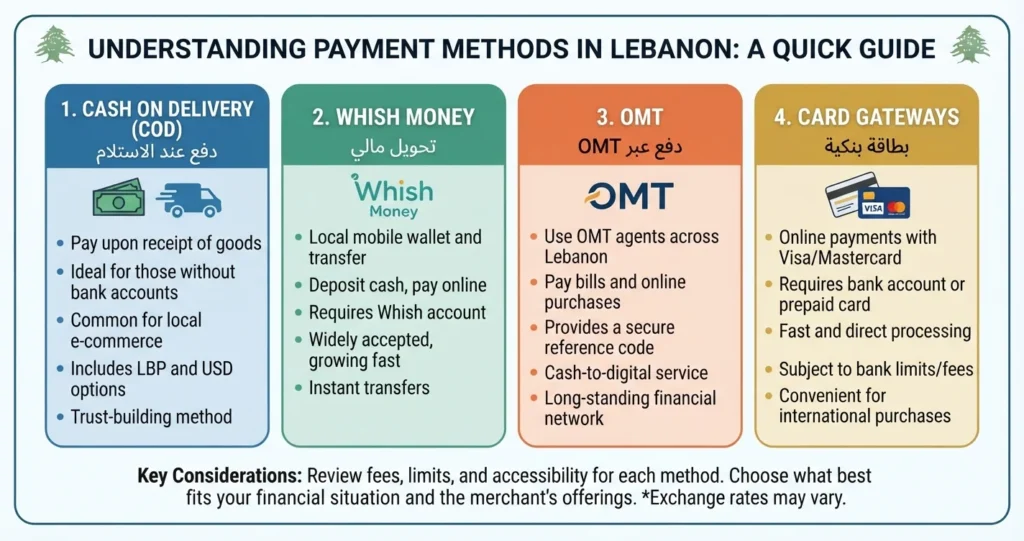
Cash on Delivery in Lebanon
Cash on delivery in Lebanon remains the most familiar way to pay for online orders. Local e-commerce guides published in 2026 describe it as the default for a large share of orders, and one estimates it at around 60 to 70 percent of transactions. Treat that as an indication rather than an official statistic. Either way, it’s clear that most Lebanese stores can’t afford to drop COD.
The upside
COD removes the biggest objection for hesitant buyers: they don’t pay until they see the product. It works for customers without cards or wallets, and it builds trust for new or unknown brands.
The downside
COD brings costs that card payments don’t. Some customers refuse orders at the door, which means wasted delivery fees and stock tied up in transit. Cash has to be collected from couriers and reconciled, which takes time and can delay your cash flow. And handling cash introduces security and accounting overhead.
Making COD work better
Confirm COD orders by WhatsApp or phone before dispatch, especially for high-value items. Show the full price, including delivery, clearly at checkout so there are no surprises at the door. Agree clear settlement terms with your courier: how often they pay out, in which currency and how returns are handled. Some stores ask for a small deposit on large or custom orders.
Wallets: Whish and Others
Digital wallets have become an important bridge between cash and online payments. Customers load money onto a wallet, often in cash at a local agent, then pay online from their balance without using a bank card.
Whish Money is one of the best-known wallets in Lebanon. Whish says its online payment service works with Shopify, WordPress and custom websites, and in 2025 it announced a Shopify integration offering a cardless checkout option. For a Whish Money online store setup, check the current merchant requirements, fees and settlement terms directly with Whish. That includes whether funds settle to a Whish balance or a bank account, and how quickly.
Wallet payments can be especially useful for younger shoppers and for customers who already use wallets to send and receive money. Offering one gives these buyers a way to pay instantly without a card, which reduces the risks that come with cash on delivery.
Money-Transfer Payments: OMT
OMT and similar money-transfer networks are widely used in Lebanon, and some businesses accept payment through them, particularly for B2B orders, custom work or high-value purchases. The customer transfers the amount through an OMT agent or app, shares the reference number, and the store confirms the payment before dispatching.
This approach is manual. It usually involves confirming each payment rather than an automated checkout, so it suits lower-volume or high-value orders more than fast-moving retail. If you offer it, explain the steps clearly on your site, set a time limit for payment and tell customers how quickly you’ll confirm.
Card Payment Gateways
A payment gateway in Lebanon lets customers pay by Visa, Mastercard or other cards directly on your site. Card payments are faster to process, avoid cash handling and suit customers with working cards, including Lebanese buyers abroad and international visitors.
Options for Lebanese merchants
Lebanese guides published in 2026 point to providers such as Areeba, a regional payment processor that lists Lebanon among its markets, and Tap Payments, which offers online payments and payment links in Lebanon. Areeba typically works through partner banks, which may mean more paperwork and longer onboarding. Tap supports integrations with platforms such as Shopify and WooCommerce. Card approval often requires a registered business and an approved merchant account. That process can take longer than building the store itself, so start early.
What doesn’t work?
Some global payment providers aren’t available to Lebanese-registered businesses. Stripe, for example, doesn’t list Lebanon among its supported countries, and Shopify’s own payment processing isn’t available to Lebanese merchants. That means Shopify stores in Lebanon rely on third-party providers, with Shopify’s own transaction fees applying on top of the provider’s fees. On WooCommerce there’s no platform transaction fee, but you’ll install and maintain the gateway plugin yourself.
Payment links
Many providers also offer payment links that you can send by WhatsApp, Instagram DM or email. For stores that sell heavily through social media, payment links can be a practical first step before a full checkout integration.
Comparing the Online Payment Options in Lebanon
| Option | Best for | Main strengths | Main drawbacks |
|---|---|---|---|
| Cash on delivery | Most consumer stores | Familiar, builds trust, no card needed | Refused orders, slow cash collection, handling risk |
| Wallets (e.g. Whish) | Younger and wallet-using shoppers | Instant, no card needed, can be automated | Customer needs a funded wallet |
| Money transfer (e.g. OMT) | B2B, custom and high-value orders | Widely trusted, no card needed | Manual confirmation, slower |
| Card gateway | Customers with working cards, diaspora and visitors | Automated, fast, scalable | Merchant approval, fees, card acceptance varies |
Designing a Checkout That Converts
The right mix matters, but so does how you present it. Payments are a conversion and user-experience decision, not just a list of gateways.
Offer two or three options, not seven
When it comes to online payment options in Lebanon, more isn’t better. Most Lebanese stores do well with cash on delivery plus one or two digital options, such as a wallet and a card gateway. Too many choices can confuse customers and add maintenance work.
Be clear about currency
Show prices clearly in US dollars or Lebanese pounds, and state which currency each payment method uses. If you accept both, explain the exchange rate you apply. Unclear pricing is one of the fastest ways to lose a buyer at checkout.
Show trust signals
Display delivery times, delivery fees, return and exchange policies, and a clear way to reach you, ideally on WhatsApp. Use recognisable payment logos and secure checkout pages. For new brands, real customer reviews make a noticeable difference.
Design for mobile
Most shoppers will check out on a phone. Keep forms short, avoid unnecessary account creation, use clear buttons and test every payment method on real devices before launch.
Selling to Lebanese abroad
If you sell to diaspora customers buying gifts for family in Lebanon, a working card gateway matters more, because those buyers often prefer to pay by card from abroad. Make it clear who pays, who receives and where delivery takes place.
Costs and Settlement
Lebanese payment providers don’t always publish standard rate cards, so ask each provider for written offers. Compare transaction fees, any setup or monthly fees, settlement currency, payout speed and refund handling. Include courier fees for COD and the cost of failed deliveries. Factor all of this into your overall budget; our guide to website costs in Lebanon explains how e-commerce features affect the cost of a build.
A Payment Setup Checklist
Before launch, make sure you can answer yes to these five questions:
- Have you chosen two or three payment methods that match how your customers actually pay?
- Are merchant accounts approved and settlement terms agreed in writing?
- Is currency clearly displayed for every price and payment method?
- Have you tested every option on mobile, including refunds and order confirmations?
- Is there a process for COD confirmation, courier settlement and failed deliveries?
An example
Picture a Beirut skincare brand launching its first online store. It offers cash on delivery for all orders within Lebanon, with WhatsApp confirmation for orders above a set value. It adds Whish for customers who prefer to pay instantly from a wallet, and a card gateway mainly for Lebanese customers abroad sending gifts home. Prices are shown in US dollars, delivery fees are clear at checkout, and the returns policy sits beside the payment options. After three months, the brand reviews which methods customers choose, how many COD orders are refused and how quickly each method settles, then adjusts. This is an illustrative scenario, not a client example.
Choose Payments Your Customers Trust
The best online payment options in Lebanon are the ones your customers already trust and use. For most stores, that means cash on delivery supported by one or two digital methods, such as a wallet and a card gateway, presented clearly at checkout with transparent pricing in the right currency. Get approvals started early, test everything on mobile and review your mix as customer habits change.
Plan your online store with us
mediaSine builds e-commerce sites for Lebanese brands, with checkout and payment options designed around how your customers actually pay
Frequently Asked Questions
The main options are cash on delivery, digital wallets such as Whish, money-transfer payments through networks like OMT, and card payment gateways from providers that serve Lebanese merchants. Most stores combine COD with one or two digital methods.
Not as a Lebanese-registered business. Stripe doesn’t list Lebanon among its supported countries, and Shopify Payments isn’t available to Lebanese merchants, so stores use third-party providers instead.
For most Lebanese stores, no. COD remains very common and builds trust. Instead, reduce its costs with order confirmation, clear pricing and good courier agreements, while encouraging digital payments where possible.
It varies by provider and depends on your business registration and documentation. Merchant approval can take longer than building the website, so start the application early.
