
Sooner or later, most growing Doha businesses face the same shortlist: a smaller agency based in Qatar, and a bigger regional name run from Dubai, Riyadh or Beirut. One promises closeness and local instinct. The other promises scale, specialists and polished process. Choosing between a local vs regional marketing agency in Qatar isn’t about which type is better in general. It’s about which trade-offs your business can live with.
This guide lays out those trade-offs honestly, including where each model tends to struggle, so you can make the call with your eyes open. It’s written for owners and marketing managers weighing digital marketing in Qatar who want a partner that will still feel like the right choice a year from now.
What “Local” and “Regional” Really Mean in Qatar?
The labels are looser than they sound. A local agency usually means a team based in Doha, serving mainly Qatari clients, with its people, meetings and shoots in the country. A regional agency usually means a firm headquartered elsewhere in the Gulf or the Levant, serving several markets, with Qatar as one of them.
The labels can mislead you in both directions. Some agencies with a Doha address do much of their production elsewhere. Some regional agencies have people on the ground in Qatar every week. So before you compare models, find out where the people who will actually work on your account sit, and how often they’re in the country.
This is also why search results can be confusing. Look for a digital marketing company in Doha and you’ll find Qatar-registered firms, regional agencies with Qatar landing pages, and directory listings mixing both. The page you land on tells you how an agency wants to be found, not necessarily how it delivers. Treat the address as a starting point for questions, not as the answer.
The hybrid model in between
Many agencies now sit somewhere in the middle: a regional team for strategy, design and production, combined with Qatar-based or Qatar-dedicated people for client contact, shoots and local knowledge. Done well, this gives you some of the advantages of both. Done badly, it gives you a local face on a remote operation. The questions later in this guide will help you tell which one you’re looking at.
Where a Qatar-Based Agency Has the Edge?
Being in the market brings advantages that are hard to replicate from a distance. They matter most for consumer brands whose customers live and spend in Qatar.
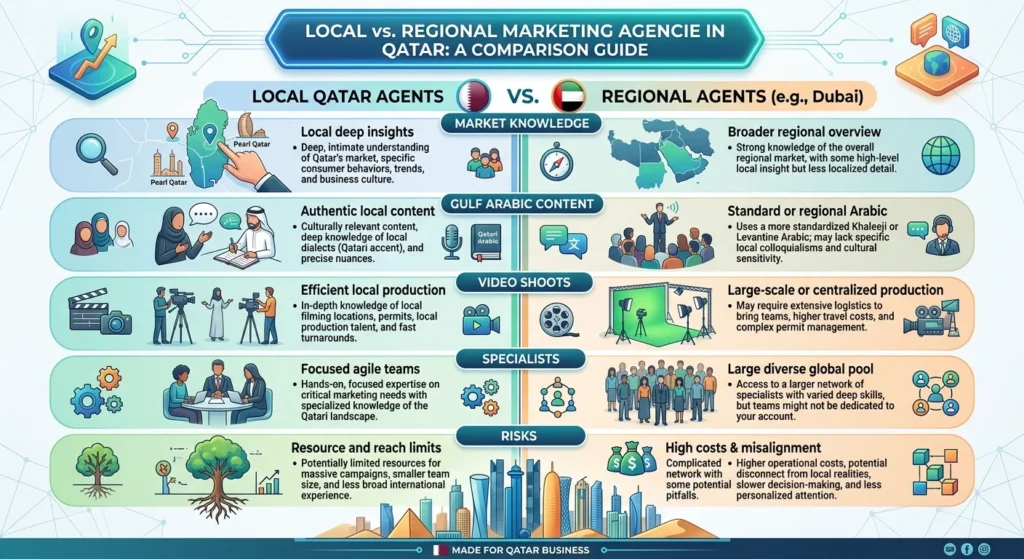
Market knowledge and Gulf Arabic
A team living in Doha absorbs the market without trying: which neighbourhoods are busy on which nights, how Ramadan changes daily routines, which local events everyone is talking about, how Qatari and expatriate audiences respond differently. That knowledge shows up in content. So does language. Arabic written for a Gulf audience reads differently from Levantine or Egyptian Arabic, and customers notice when it’s off. A local team is more likely to get tone, references and dialect right the first time.
Being there for shoots, meetings and launches
Plenty of marketing still happens in person. A restaurant needs its dishes photographed in its own kitchen. A boutique needs a shoot when the new collection lands. A launch event needs someone there with a camera and a plan. A Doha-based team can usually book a shoot this week rather than next month, and can meet you face to face when something needs a proper conversation. For brands that depend on social media in Qatar, that speed and presence often matter more than anything else in the proposal.
Local rules and approvals
Qatar has its own procedures for some common marketing activities. Running discounts, giveaways or prize promotions on social media, for example, can require approval from the Ministry of Commerce and Industry. A team that works in the market every day is more likely to know the current process and build the time into your campaign plan. We explain the basics in our guide to promotion permits.
Where a Regional Agency Has the Edge?
Regional agencies aren’t simply bigger. They’re often built differently, and some businesses benefit from that.
Depth of specialists
A firm serving several markets can afford specialists that a small local team may not: a dedicated paid media buyer, an SEO lead, a motion designer, a data analyst. If your marketing needs several advanced skills at once, a larger bench can mean less learning on your budget.
Campaigns across more than one market
If you sell in Qatar, the UAE and Saudi Arabia, a regional agency can plan one campaign and adapt it market by market, keeping your brand consistent while sharing creative costs. For a business expanding across the Gulf, that coordination can be worth a great deal.
Process and systems
Larger agencies tend to have formal processes: structured onboarding, approval workflows, reporting dashboards and documented ways of working. That can make them easier to manage for companies with procurement teams or multiple stakeholders.
The Risks on Each Side
Both models have a familiar failure mode. Knowing them in advance makes them easier to spot during the pitch.
Qatar treated as a satellite
The biggest risk with a regional agency is that Qatar gets the leftover attention. Campaigns are designed for Dubai or Riyadh and then adapted with a change of hashtag. Content uses the wrong dialect or misses local moments like Qatar National Day. Meetings happen on video calls across time zones, since Qatar runs an hour behind the UAE. None of this is inevitable, but it’s common enough to ask about directly.
Small local teams stretched thin
The biggest risk with a small local agency is capacity. A team of a few people can be brilliant at content and community but stretched when you need advanced ads, SEO or a website at the same time. If one key person leaves or gets busy, your account can feel it immediately. Ask who covers your work during holidays and peak seasons.
Questions That Settle the Local vs Regional Marketing Agency in Qatar Decision
When you’re hiring an agency in Qatar, these five questions cut through the labels and tell you how an agency will really work with you.
- Where are the people who will plan, create and run our content based, day to day?
- How quickly can you shoot in Doha, and who does it?
- Who writes our Arabic, and do they write for Gulf audiences natively?
- Which Qatar clients can you show us, and what did you do for them?
- How do you handle Qatar-specific approvals and seasonal campaigns?
A confident, specific answer to each is a better sign than any office address. A vague answer to the first question usually tells you everything you need to know.
Which Model Fits Which Business?
There’s no universal winner, but patterns are clear enough to guide the decision. Here’s how the choice tends to play out for different kinds of Doha businesses.
A restaurant, café or salon serving customers in one city usually benefits most from local presence: frequent shoots, quick turnaround on daily content and someone who understands the neighbourhood. A retail brand with branches in Qatar and the UAE may prefer a regional partner that can run consistent campaigns across both. A B2B company selling to government and corporate clients may care most about strategy, LinkedIn expertise and process, wherever the team sits. And a business planning to expand beyond Qatar in the next year or two should look for a partner whose footprint matches where it’s going, not just where it is today.
Making the local vs regional marketing agency in Qatar call for your business
If you’re still undecided, rank three things in order of importance to you: being in the room, depth of specialist skills, and coverage of other markets. If being in the room comes first, lean local. If specialist depth or multi-market coverage comes first, lean regional, but test hard on how Qatar will be served. If all three matter roughly equally, the hybrid model is usually the one to look at most closely.
Cost often follows scope more than geography. A regional agency isn’t automatically more expensive, and a local one isn’t automatically cheaper. Compare what each proposal includes. Our guide to social media management packages in Qatar shows how to read a package line by line.
Where mediaSine Fits?
In the interest of transparency, mediaSine is itself a cross-market agency. We work with clients in Qatar and Lebanon, which means we see both sides of this decision from the inside. Our Qatar work includes food brands such as Gourmet Qatar, and we build Qatar content around Qatari platforms, seasons and audiences rather than adapting campaigns made for another market.
Whichever agency you choose, ask it the same questions you’d ask us. A good partner, local or regional, will be glad to answer them.
Frequently Asked Questions
Not always. Local presence is a real advantage for consumer brands that need frequent shoots and local insight. Businesses with multi-market campaigns or advanced technical needs may get more from a regional team, provided Qatar gets genuine attention.
Ask for Qatar-specific work, not regional campaigns with Qatar added. Check the Arabic in their samples, ask how they planned around Ramadan or Qatar National Day, and find out who is physically available in Doha for shoots and meetings.
You can, and some businesses do. It works best when one partner owns the overall strategy and both share data and calendars. Without that, split arrangements often lead to mixed messages and finger-pointing when results dip.
Choose the Partner That Shows Up for Qatar
The local vs regional marketing agency in Qatar decision comes down to one test: which partner will give your Qatar customers the attention, language and presence they deserve? Address on the business card matters less than who does the work, where they are and how well they know the market. Ask the hard questions, compare scopes rather than labels, and choose the team that proves it understands Qatar.
Meet our Qatar team. Talk to mediaSine about your goals in Qatar, and ask us the same questions you’d ask any agency. Book a conversation with us.
