
A beautiful feed doesn’t pay the rent. Plenty of Beirut restaurants have gorgeous Instagram grids and half-empty dining rooms on a Tuesday night. Others post less often, with less polish, and still have a waiting list. The difference is rarely the photography. It’s whether their Instagram marketing for restaurants is built around the moment someone decides where to eat, and whether it makes booking a table easier than scrolling past.
This guide is for restaurant and café owners in Beirut who want Instagram to bring people through the door, not just collect likes. It covers how diners find restaurants on the app, which formats earn attention, when to post, how to work with reviews and creators, and how to turn messages into reservations. If you would rather have a team run it, our page on social media management for restaurants explains how mediaSine approaches F&B accounts.
How Beirut Diners Discover Restaurants on Instagram?
Think about how a dinner plan actually forms. A friend sends a Reel in a group chat. Someone sees a dish on a creator’s story and saves it for the weekend. A couple searching for somewhere new in Mar Mikhael or Badaro taps through a few profiles before settling on one. Instagram works less like a billboard and more like a menu people browse before they’ve even decided to go out. Successful Instagram marketing for restaurants starts by accepting that role: your account is a place people come to make a decision, so every part of it should help them make one in your favour.
That has a practical consequence. Your profile is often judged in under ten seconds. Before anyone reads a caption, they check your bio, your pinned posts, your Highlights and the last few Reels. If those answer the obvious questions (what you serve, roughly what it costs, where you are, when you’re open and how to book), you’re already ahead of many competitors.
Fix the profile before you post more
Start with the basics that convert visitors into guests. Your bio should say what you are in plain words (“Neighbourhood Italian, Gemmayzeh” beats a clever slogan), followed by opening hours or a booking prompt. Use the contact buttons Instagram offers business accounts, such as call, directions and a WhatsApp button, so a hungry visitor can act in one tap. Pin three posts that represent you best: a signature dish, the space, and something that shows the experience, like a busy Friday night.
Highlights are underused by most restaurants. Treat them as your digital menu board: a Menu Highlight with clear photos and prices, a Location Highlight with a short clip of how to find you and where to park, and an Events Highlight for live music or special nights. These rarely change, and they quietly answer the questions people would otherwise DM you about.
Reels, Stories and Menu Highlights: Formats That Earn Attention
Each format has a different job. Treating them all the same is one of the most common mistakes in restaurant social media in Lebanon.
Reels bring new people in
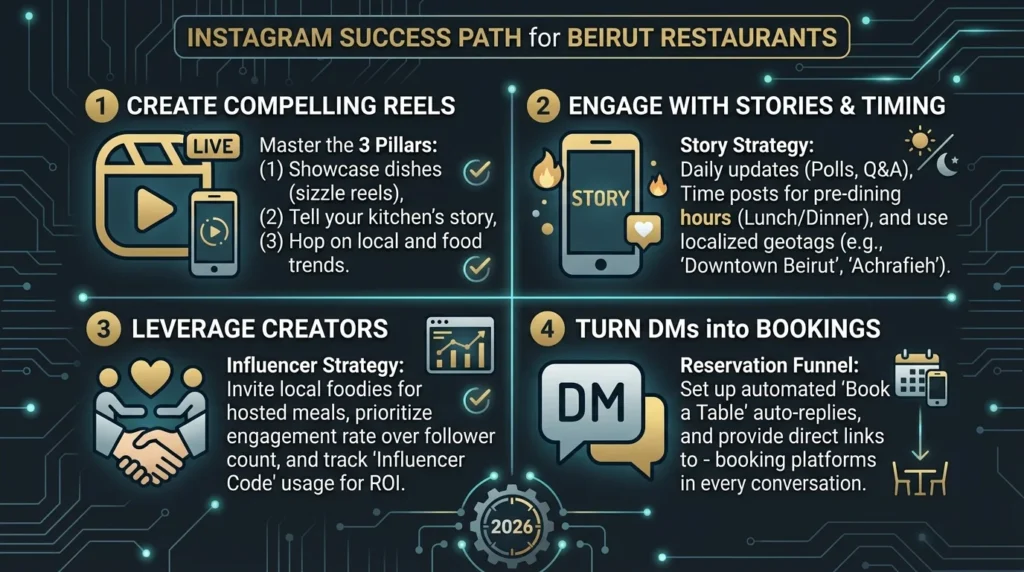
Reels are how you reach people who don’t follow you yet. The ones that work for restaurants are usually simple: a cheese pull, a sizzling grill, a dessert being plated, a bartender building a signature cocktail. Movement and sound sell food in a way a still photo can’t. Keep them short, open on the most appetising moment rather than a logo, and add on-screen text that names the dish and your area so the Reel still makes sense with the sound off.
Stories keep regulars coming back
Stories are for people who already know you. Use them for today’s special, a new dessert, the fact that the terrace is open, or a last-minute table on a quiet night. They don’t need to be polished. A quick clip from the kitchen at 6 pm, with a reservation link or a “message us to book” sticker, often does more for a slow evening than a carefully designed post.
Feed posts and carousels make the case
Carousels are useful when you need to explain something: a new menu, a set lunch, a brunch offer with what’s included. They also tend to be saved, which matters because a saved post is often a plan for later. Here are some restaurant Instagram ideas for Beirut that tend to suit carousels:
- A “what to order on your first visit” guide with your top four dishes
- A behind-the-scenes look at a signature dish, from market to plate
- A weekly specials board for the coming days
- An introduction to the chef or the team behind the bar
Posting Around Service Times and Seasons
Good timing is one of the cheapest wins in Instagram marketing for restaurants. The goal is to appear when people are deciding, not when you happen to have a free moment.
Daily timing
Lunch decisions are made late morning; dinner plans form in the afternoon, and weekend plans are often made midweek. Post a lunch special Story before noon and a dinner Reel in the late afternoon rather than after service, when people are already eating somewhere else. Your own Instagram insights will show when your followers are most active, so treat any general advice, including this, as a starting point and test it against your own numbers.
The Lebanese calendar
Beirut’s dining year has clear peaks. Summer brings visitors and returning diaspora who want to eat out often. Ramadan shifts the focus to iftar and suhoor offers. December fills up with Christmas and New Year’s Eve bookings, and dates like Valentine’s Day and Mother’s Day on 21 March drive set menus and reservations. Plan content for these moments at least a few weeks ahead, because people book early for the busy nights. Our monthly restaurant content calendar gives you a structure for mapping these dates against your regular posts.
Reviews, Reposts and Creator Visits
People trust other diners more than they trust your captions. The best restaurant accounts make it easy for guests to talk about them, then share what guests say.
Make your restaurant easy to post about
Some restaurants are photographed constantly because they’ve designed for it: good lighting at the table, a dish that looks dramatic, a sign or wall people like to stand in front of. You don’t need a renovation to benefit. Plating one or two dishes for the camera, and making sure your handle is visible on menus or table cards, gives guests a reason and a reminder to tag you.
Repost with permission and gratitude
When guests tag you, reshare their Stories and thank them. It costs nothing, shows real people enjoying your food and encourages others to tag you too. For feed posts, ask permission before reposting a guest’s photo and credit them clearly.
Work with creators carefully
Food creators and bloggers can bring a burst of new visitors, but results vary widely. Look beyond follower counts. Check whether a creator’s audience is actually local, whether their comments come from real people, and whether their past restaurant posts led to visible engagement. Agree clearly what will be posted and when, and make sure any paid or hosted visit is disclosed. A creator whose followers live in Beirut and love food is usually worth more than a much larger account with a scattered audience.
Turning DMs and WhatsApp Into Bookings
Here’s where many restaurants lose the guests their content worked hard to attract. Someone sees a Reel, messages to ask if there’s a table for four on Saturday, and gets a reply the next afternoon. By then, they’ve booked elsewhere.
Treat your inbox as part of your reservation system. Agree who answers messages during service hours, and set response expectations for the team. Saved replies help with the questions you get every day: opening hours, parking, whether you take bookings, whether there’s a vegetarian option. A WhatsApp button on your profile can move booking conversations to a channel your team may already use for reservations. Whichever route you choose, the rule is the same: the faster and simpler the reply, the more messages turn into covers.
It also helps to ask guests where they heard about you when they book or arrive. It’s a simple habit, but it gives you something that platform data can’t: a direct link between your posts and real tables filled.
What to Measure in Instagram Marketing for Restaurants?
Likes feel good, but they don’t tell you whether Instagram is working for the business. Focus on the numbers that sit closest to a booking.
- Profile actions: taps on call, directions, WhatsApp and website buttons
- Messages: how many enquiries came in, and how many became bookings
- Saves and shares: signs that people are planning a visit or recommending you
- Reach from non-followers: whether your Reels are finding new diners
- Guest feedback: how many guests say they found you on Instagram
Review these monthly rather than daily. A single Reel can spike and dip; a three-month trend tells you whether your approach is working. If profile actions and messages are rising while reservations stay flat, the problem is probably in how you handle enquiries, not in your content.
Common mistakes in Instagram marketing for restaurants
A few patterns come up again and again. Posting only polished photos and never showing the atmosphere or the people. Letting Highlights go stale, so the menu shown is last year’s. Running ads before the profile is ready to convert visitors. And going silent during the busiest weeks, which is exactly when people are deciding where to go. Fixing these often does more than any new content idea.
Examples From the Food and Restaurant Sector
Food and restaurant brands make up a meaningful part of mediaSine’s portfolio in Lebanon, including 10-10 Resto, Patty Co, Pick a Bite and Fit Treats. Each of these brands has different guests and a different reason for people to visit, which is why we don’t apply one template to every restaurant. A burger spot built on late-night cravings needs a different Instagram rhythm from a healthy snack brand or a sit-down family restaurant.
The principles in this guide are the ones we return to across that work: a profile that answers questions fast, Reels that lead with the food, Stories that fill quiet nights, and an inbox that turns interest into bookings.
Frequently Asked Questions
Consistency matters more than volume. A few strong feed posts or Reels a week, plus regular Stories on service days, is a realistic rhythm for most restaurants. Post less but keep going, rather than posting daily for a month and then disappearing.
Not always, but it helps. Organic content builds your profile and community; a modest, well-targeted ad budget can push your best Reels to people nearby who don’t follow you yet. Make sure your profile and inbox are ready before you spend.
Follow your guests. Many Beirut restaurants mix English with Arabic, and some add French for certain audiences. Look at the language your followers use in comments and messages, and write in the language that feels natural for your brand.
For your menu, pinned posts and Highlights, professional photos are worth the investment because they’re seen constantly. For Stories and everyday Reels, well-lit phone footage often feels more authentic and performs just as well.
Turn Your Feed Into Full Tables
Effective Instagram marketing for restaurants isn’t about posting more. It’s about being useful at the moment someone is deciding where to eat: a profile that answers their questions, content that makes them hungry, timing that catches them while they’re planning, and a reply that confirms their table before they look elsewhere. Get those four things right, and Instagram becomes one of the most reliable sources of guests you have.
Talk to us about your restaurant’s social media.
mediaSine plans, shoots and manages Instagram for food and restaurant brands, with a focus on bookings rather than vanity numbers
