
Every business owner who invests in SEO eventually asks the same question, usually around month two: is this working yet? It’s a fair question, because SEO doesn’t behave like paid ads. There’s no switch that turns traffic on. Instead, results build gradually as search engines crawl, understand and start to trust your site. So how long does SEO take? The honest answer is “months, not weeks”, but the details matter, and they depend heavily on where your site starts and what you’re trying to rank for.
This guide gives you realistic expectations: what Google itself says, what “results” actually means, a month-by-month timeline, the factors that speed things up or slow them down, and what that looks like for businesses in Lebanon. If you’re weighing up support, see mediaSine’s SEO services in Lebanon.
The Short Answer: How Long Does SEO Take?
The most widely cited benchmark comes from Google. In its “How to Hire an SEO” video, Google’s Maile Ohye explained that SEOs typically need four months to a year to help a business first implement improvements and then see potential benefit. That range still holds up well today.
Industry surveys point the same way. A poll of thousands of SEO professionals reported by Ahrefs found that most expect meaningful progress within three to six months, with a sizeable minority saying seven to twelve months. Google’s John Mueller has also noted that it can take up to a year for Google to work out where a brand-new site should rank.
Put simply, a sensible SEO timeline for most businesses looks like this: early signals within the first few months, meaningful traffic growth somewhere between four and twelve months, and compounding returns after that.
What “Results” Actually Means?
Part of the confusion comes from different definitions of success. SEO progress usually shows up in stages, and each stage arrives at a different time.
First come technical signals: pages being crawled and indexed properly, errors fixed, the site loading faster. Next come impressions, as your pages start appearing in search results more often, even if they’re not yet on page one. Then rankings improve, typically for long-tail and lower-competition searches first. Traffic follows rankings, and enquiries and sales follow traffic.
So when will SEO show results? Technical improvements and impressions often move within weeks. Rankings for specific, less competitive searches can improve within a few months. Leads and revenue from organic search usually take longer, because they depend on everything before them.
A Month-by-Month SEO Timeline
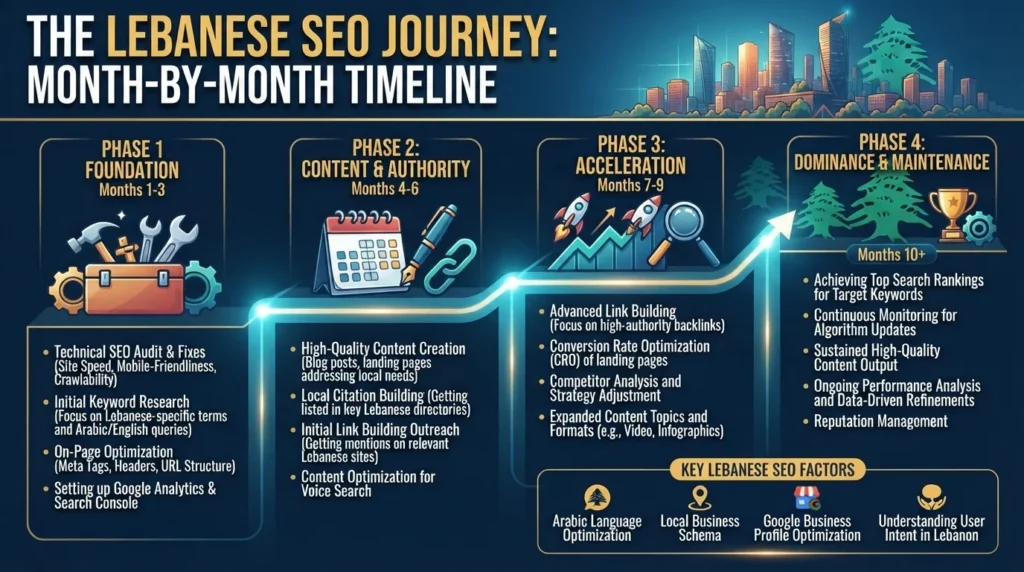
Every project is different, but a well-run SEO campaign for an established small or medium business often follows a pattern like this.
Months 1 to 2: audit and foundations
The work starts with understanding the site and the market: a technical audit, keyword research, competitor analysis and fixing the biggest problems. That might mean cleaning up duplicate pages, improving page speed, fixing broken links, setting up Google Search Console and analytics, and optimising your Google Business Profile. Visible results are limited at this stage, but the foundation determines everything that follows.
Months 3 to 4: early signals
Improved and new pages start being indexed, impressions rise and some rankings begin to move, especially for specific searches with lower competition. Local visibility can improve noticeably if your Google Business Profile and local signals were weak before.
Months 4 to 6: first real traction
Rankings for target keywords begin to climb into the first or second page, organic traffic increases and the first enquiries from search often appear. This is usually when it becomes clear whether the strategy is working and which areas deserve more investment.
Months 6 to 12: growth
Content, internal linking and authority-building start to compound. More pages rank, more searches bring traffic, and organic search becomes a reliable source of leads. Competitive terms may still be climbing, but the overall trend should be clearly upwards.
Year two and beyond
SEO keeps paying off as long as it’s maintained. Strong pages continue to attract traffic with relatively little additional cost, while new content and refreshed pages extend your reach. Businesses that stop entirely often see gains erode as competitors keep improving.
What Speeds Up or Slows Down SEO?
The range of four months to a year is wide because a few factors make a big difference.
Your site’s age and history
An established site with some authority usually moves faster than a brand-new domain. Sites with a history of penalties, spammy links or major technical problems may need extra time to recover.
How competitive your searches are
Ranking for a specific long-tail search in your city is far easier than ranking for a broad, high-value term that dozens of established businesses target. The more competitive the search, the longer it takes.
Technical health
Slow pages, indexing errors, duplicate content and poor mobile experience all act as brakes. Fixing them early often produces some of the quickest gains, because every other improvement depends on search engines being able to crawl and understand your pages.
Content and implementation speed
SEO recommendations only help once they’re implemented. Businesses that approve changes quickly, publish useful content regularly and keep improving pages see results sooner than those where recommendations sit in a queue for months.
SEO Timelines in Lebanon
The Lebanese market has its own characteristics. Local searches, such as a service plus a city or neighbourhood, often move relatively quickly, especially when a business improves its Google Business Profile, reviews and location pages. Many local competitors have weak technical foundations, which gives well-optimised sites an opening.
Broad national terms are a different story. For many high-value searches in Lebanon, directories and long-established businesses occupy the top results, so climbing there takes sustained effort and patience. Language adds another layer: Lebanese users search in English, Arabic and sometimes French, so a strategy that covers the right language for each audience can open up searches competitors ignore. And businesses targeting Lebanese customers abroad may face a different set of competitors and timelines in each market.
An example: a dental clinic in Beirut
Picture a dental clinic in Achrafieh with an older website and a basic Google Business Profile. In the first two months, the clinic fixes slow pages, rewrites its service pages, adds treatment-specific content in English and Arabic, and completes its Google profile with photos, hours and services. By month three or four, it starts appearing for searches such as a specific treatment plus “Achrafieh” or “Beirut”, and calls from Google Maps increase. Between months six and twelve, it ranks for more treatments and nearby areas, and organic search becomes a steady source of new patients. Broader searches like “dentist Lebanon” remain harder and take longer. This illustrative scenario shows why the answer to how long does SEO take depends so much on which searches you’re measuring.
How to Get Faster Wins?
You can’t skip the process, but you can prioritise work that tends to deliver sooner:
- Fix technical blockers such as indexing errors, slow pages and duplicate URLs
- Improve pages already ranking on page two or three, where small gains bring clicks
- Optimise your Google Business Profile and gather genuine reviews
- Target specific, long-tail searches before broad, competitive ones
- Redirect old pages that still have value instead of deleting them
For online stores, product and category pages have their own priorities. We’ll cover them in our guide to e-commerce SEO.
Using Paid Search While SEO Builds
Because SEO takes time, many businesses run paid search or social ads alongside it. Paid campaigns can generate enquiries almost immediately, test which keywords and messages convert, and keep the phone ringing while organic visibility grows. As SEO starts to deliver, you can gradually shift budget away from paid clicks for searches where you rank well organically, and keep paid activity for competitive terms, promotions or new services. The two channels work best together: paid search for speed, SEO for durable, compounding visibility.
Beware of Guarantees
If someone promises first-page rankings within a few weeks, be cautious. Google’s own guidance on hiring an SEO warns that no one can guarantee a number one ranking. Fast, guaranteed results often rely on tactics such as buying links that can backfire and damage your site. A trustworthy SEO partner will explain what’s realistic, what depends on your competition and implementation, and how progress will be measured.
Measuring Progress Along the Way
Because SEO takes time, it’s important to track the leading indicators, not just sales. Google Search Console shows impressions, clicks, average position and the queries your pages appear for. Watch for rising impressions and improving positions in the early months, then growing clicks, traffic to key pages and organic enquiries as the campaign matures. Review monthly, compare against your baseline and focus on the trend rather than week-to-week fluctuations.
It also helps to agree on milestones at the start. For example: technical fixes completed by month two, rising impressions for priority pages by month three, first-page positions for several long-tail searches by month six, and a measurable share of enquiries from organic search by month twelve. Milestones like these turn a long, uncertain wait into a series of visible checkpoints, and they make it easier to have honest conversations if progress stalls.
Patience With a Plan
So, how long does SEO take? For most Lebanese businesses, expect early signals within a few months, real traction between four and twelve months, and compounding returns beyond that. Where you land in that range depends on your site’s history, your competition, your technical health and how quickly improvements are implemented. With realistic expectations, clear measurement and steady work, SEO becomes one of the most valuable long-term investments a business can make.
Request an SEO audit.
Find out where your site stands, what’s holding it back and what a realistic timeline looks like for your business.
Frequently Asked Questions
New sites usually take longer, often six to twelve months or more, because search engines need time to discover, crawl and trust them. Focusing on specific long-tail searches and local SEO can help a new site gain early traction.
Some technical fixes and local improvements can produce early movement within weeks, but meaningful, lasting traffic growth usually takes several months.
For most businesses, yes. Unlike paid ads, which stop when spending stops, strong SEO keeps bringing in traffic over time. Many businesses use paid search for short-term leads while SEO builds long-term visibility.
Scaling back is possible, but stopping entirely often leads to gradual declines as competitors improve and search results change. Ongoing maintenance protects your rankings.
