
Many brands entering Saudi Arabia take their English website, translate the text, flip the layout and call it done. Saudi visitors notice. Menus look awkward, numbers and English words break up sentences, fonts look thin or mismatched, and important trust details are missing. Good Arabic website design is built for Arabic readers from the start: it handles right-to-left layouts properly, works beautifully on phones and shows the signals Saudi customers look for before they enquire or buy.
This guide covers right-to-left layout, Arabic typography, mobile-first design, the trust signals that matter in Saudi Arabia, bilingual sites and a practical checklist. If you’re planning a new site, see mediaSine’s website design services.
Why Arabic Website Design Is More Than Translation?
Arabic reads right to left, uses connected letters with different shapes depending on position, and often appears alongside English words, numbers and brand names. That affects navigation, layout, typography, forms and even which icons make sense. A site designed in English and mirrored later usually carries small problems on every page. Treating Arabic website design as its own discipline avoids them.
Expectations matter too. Saudi users are digitally sophisticated, mobile-first and used to polished local and international apps. A site that feels translated signals that the brand doesn’t fully understand the market, while one designed natively in Arabic signals commitment and builds trust.
Getting Right-to-Left Layouts Right
Strong RTL web design mirrors the overall reading flow without mirroring everything blindly.
Mirror the structure
In an Arabic layout, the logo usually sits on the right, navigation reads from right to left, text aligns right and sidebars switch sides. Breadcrumbs, progress steps and carousels should also flow from right to left, so “next” points left and “back” points right.
Know what not to mirror
Some elements shouldn’t flip. Logos stay as designed. Media controls such as play buttons usually keep their standard direction. Phone numbers, prices and many numbers read left to right even within Arabic text. Icons with universal meaning, like a search magnifying glass, generally stay the same, while directional icons such as arrows should flip. Review each icon individually rather than mirroring the entire set.
Handle mixed Arabic and English text
Arabic pages often include English brand names, product codes, email addresses and numbers. Without care, punctuation and word order can display incorrectly when the two directions mix. Developers should set the correct text direction for each element and test real content, not placeholder text, to catch display errors.
Design forms for Arabic users
Labels, placeholders and error messages should be in Arabic and aligned right, while fields such as email addresses and phone numbers may need left-to-right input. Use Saudi phone number formats and include Saudi cities and regions in address fields.
Arabic Typography
Typography can make or break an Arabic site. Many Latin fonts include weak Arabic support or none at all, leaving browsers to fall back on default fonts that clash with the design.
Choose a high-quality Arabic typeface designed for screens, with weights that match your Latin font so bilingual pages feel consistent. Arabic script often needs a slightly larger size and more generous line height than Latin text to stay legible, especially on mobile. Avoid overly decorative calligraphic fonts for body text; save them for headings or brand moments where they add character. Check that fonts load quickly, because heavy font files slow down mobile pages.
Numbers and dates
Decide whether to use Western digits or Arabic-Indic digits, and apply the choice consistently across prices, phone numbers and dates. Saudi users are familiar with both. If you display dates, consider whether customers expect Gregorian dates, Hijri dates or both for things like delivery estimates and events.
Designing for Mobile-First Saudi Users
Internet use in Saudi Arabia is close to universal, and much of it happens on phones. Design for small screens first: thumb-friendly navigation, clear buttons, short forms, fast loading and click-to-call or WhatsApp options. Test on real devices in both Arabic and English, paying attention to how Arabic text wraps and how menus behave in a right-to-left layout. A site that looks perfect on desktop but struggles on a phone will lose most Saudi visitors. Pay particular attention to sticky headers and menus, which can take up too much of a small screen once Arabic labels are added, and to checkout steps, where every extra field increases the chance of abandonment.
Trust Signals Saudi Users Look For
Trust is especially important for brands new to the Kingdom. Several signals help visitors feel confident, and some are tied to legal requirements for online businesses.
Business details and verification
Online stores in Saudi Arabia generally need to operate under a commercial registration or eligible freelance certificate, and the Ministry of Commerce directs e-store owners to verify their stores through the Saudi Business Center’s Business Platform, which replaced the older Maroof platform. Displaying your commercial registration number, VAT number where you’re registered, verification details and clear contact information reassures customers that they’re dealing with a legitimate business. Confirm current requirements with qualified advisers, as rules can change.
Local prices and payments
Show prices in Saudi riyals, and be clear about whether VAT at 15 percent is included. Offer the payment methods Saudi customers use, such as mada debit cards and Apple Pay, and make delivery times, fees and return policies easy to find.
Arabic customer service
Make it obvious how to reach you in Arabic, whether by phone, WhatsApp, chat or email, and state your working hours. A visible, responsive Arabic contact option is one of the strongest trust signals you can offer.
Reviews, address and policies
Customer reviews, recognisable client logos, a Saudi address where you have one, and clear privacy, delivery and returns policies all add credibility. Saudi Arabia’s Personal Data Protection Law also makes a clear privacy policy and careful handling of customer data increasingly important.
Content and Imagery
Design and content should work together. Write Arabic copy natively in a natural Saudi voice rather than translating English text line by line; our guide to Saudi Arabic copy covers tone and register. Choose imagery that reflects Saudi customers and settings, and design layouts around the length of the Arabic text, which often differs from the English version.
Bilingual Sites: Arabic and English
Many brands serving Saudi Arabia need both Arabic and English. Make the language switcher easy to find, keep each version complete rather than partially translated, and maintain equivalent pages in both languages. For search, use separate URLs for each language and hreflang tags so Google shows the right version to the right audience. Decide which language is the default based on your audience; for most consumer brands in the Kingdom, Arabic should lead.
E-commerce Considerations
If you’re building an online store, the platform you choose affects how well Arabic, RTL layouts, local payments and Saudi shipping are supported out of the box. Saudi platforms such as Salla and Zid are built for the local market, while international platforms offer other strengths.
An Example: Adapting a Regional Brand’s Site for Saudi Arabia
Picture a Lebanese skincare brand preparing to sell in the Kingdom. Its existing site is English-first with a partial Arabic translation. Rather than mirroring the old design, the team starts with Arabic wireframes: navigation and product grids flow right to left, product names stay in Latin script where customers search for them that way, and prices show in riyals with VAT included. A screen-optimised Arabic typeface replaces the browser fallback font. The footer shows business registration and verification details, and WhatsApp support in Arabic appears on every product page. Copy is rewritten by a Saudi writer, and mada and Apple Pay are offered at checkout. The result is a site that feels designed for Saudi customers rather than translated for them, which is the real goal of Arabic website design.
Accessibility and Performance
Good design is also inclusive and fast. Make sure text has enough contrast, buttons are large enough to tap, images have Arabic alt text and the site works with screen readers in Arabic. Compress images, limit heavy scripts and load Arabic fonts efficiently, since slow pages lose mobile visitors quickly. Strong Arabic website design treats speed and accessibility as part of the user experience, not an afterthought, and both also support search visibility.
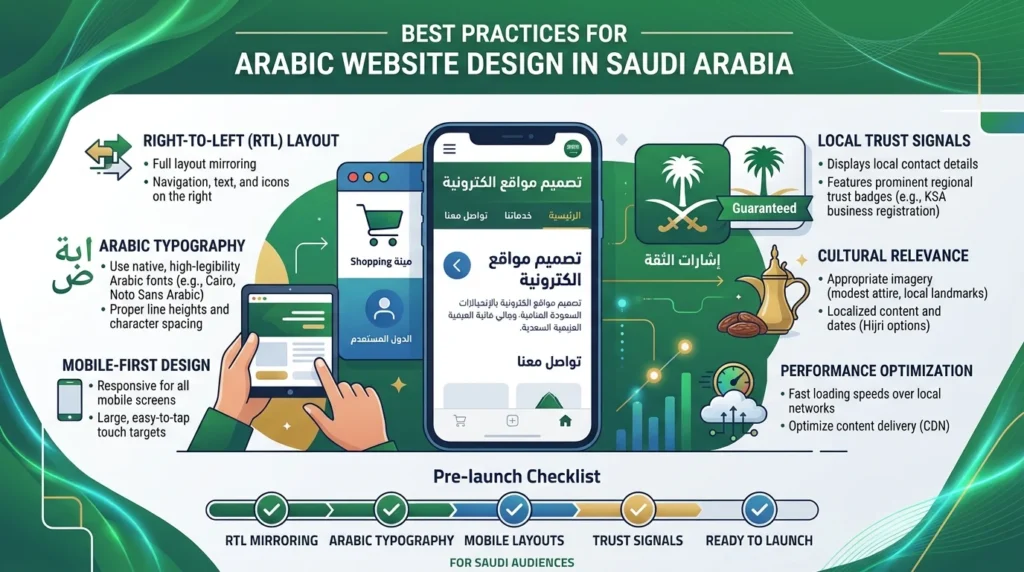
An Arabic Website Design Checklist
Before launching, check that your site meets these five standards:
- RTL done properly: layout, navigation and icons mirrored where they should be, and mixed text displaying correctly
- Strong Arabic typography: a quality screen font, readable sizes and generous spacing
- Mobile-first experience: fast, thumb-friendly and tested on real devices
- Visible trust signals: business details, verification, SAR pricing, local payments and Arabic contact options
- Native content: Arabic copy written for Saudi users and complete bilingual versions
Common mistakes in Arabic website design
The most frequent problems are mirroring logos and media controls, using fonts without proper Arabic support, testing with placeholder text instead of real Arabic content, hiding business and contact details, and launching an Arabic version that’s only partly translated. Each is easy to avoid with an Arabic-first design process, real content and a native reviewer before launch.
Design for Arabic From the Start
Effective Arabic website design starts with Arabic, not translation. Get right-to-left layouts and mixed text right, invest in good Arabic typography, design for mobile first, show the trust signals Saudi customers expect and write content natively. Do that, and your site will feel at home in the Kingdom from the first visit.
Plan an Arabic website.
mediaSine designs Arabic and bilingual websites for brands serving Saudi audiences, from RTL layouts to local trust signals.
Frequently Asked Questions
No. Mirroring is part of it, but good Arabic design also covers typography, mixed-direction text, forms, imagery, native content and local trust signals. Some elements, such as logos and numbers, shouldn’t be mirrored at all.
Choose a typeface designed for screen use with good Arabic support and weights that pair well with your Latin font. Test it on mobile at real sizes, with real content, before committing.
For most consumer brands, Arabic should be the default, with English available. B2B or specialist brands may choose English first if that’s what their buyers use, but both versions should be complete.
Online stores commonly display their commercial registration number, VAT number where registered, verification details and contact information. Confirm current requirements with qualified advisers.
